CFP: INTERNATIONAL CONFERENCE "MARGINALITY, INCLUSION, AND GENDER IN KOREA: PAST AND PRESENT"


International Conference

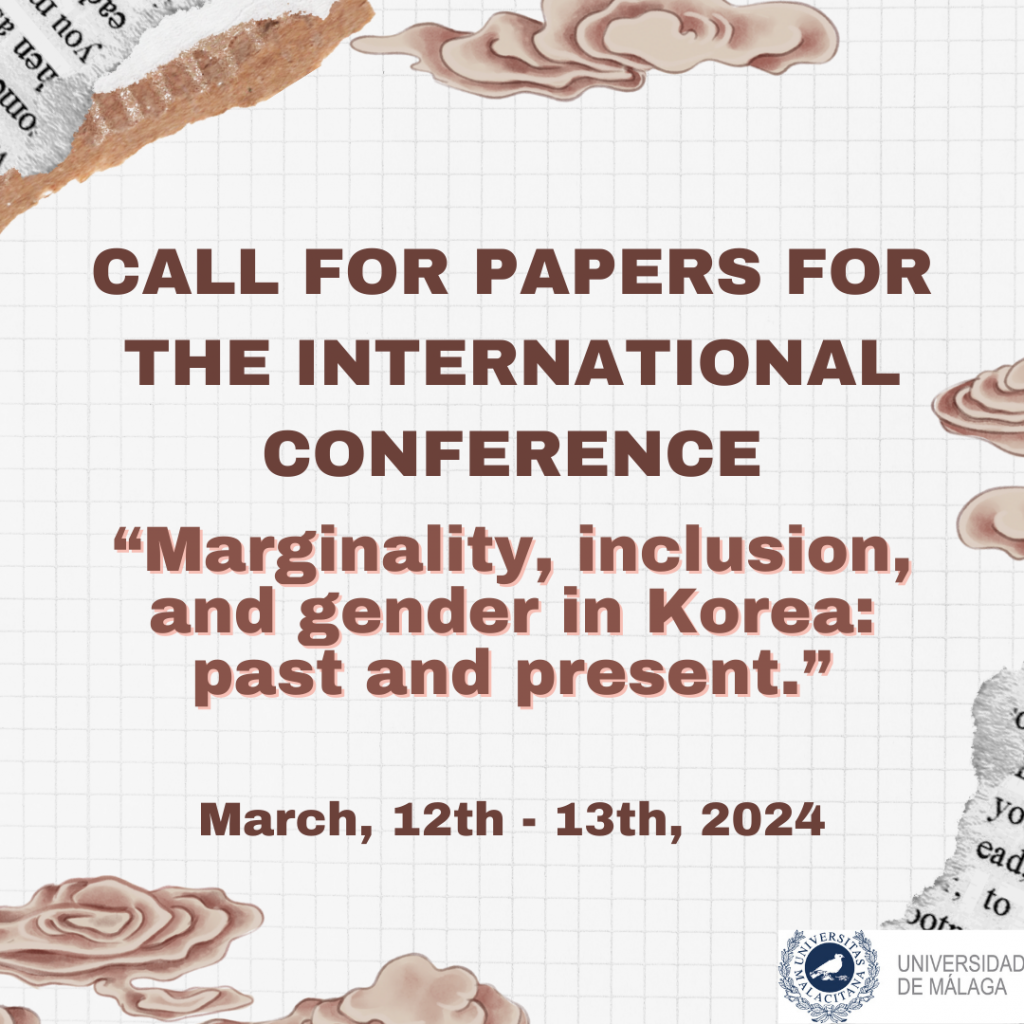
“Marginality, inclusion, and gender in Korea: past and present”


The East Asian Studies Area of the University of Malaga, Spain is pleased to announce the International Conference “Marginality, inclusion, and gender in Korea: past and present” on March 12th, 13th of 2024.

The Conference is organized as part of the research project Academy of Korean Studies Seed Program for Korean Studies (Advanced Track) “Path to Equality: Korean Studies Network on inclusiveness” (AKS-2021-INC-2250002) the Spanish National project I+D+I ASIA-SLAVES “The road to freedom in the Joseon period in Korea: Slavery and abolitionism in the context of East Asia” (PID2020-116910GB-I00) and the University of Málaga research project “Life Stories of Korean Gisaeng Slaves” (B1-2022_07).

This conference aims to consider the interrelated processes of discrimination and integration of social groups inside Korean society from a broad methodological and thematic perspective. This Call for papers encourages contributions dealing with the analysis of the cultural and institutional process of social discrimination in Korea, as well as political movements and institutional transformations directed to the integration of social groups previously discriminated against. The following topics are of interest, but are not limited to these: nobi system, discrimination against women, the situation of factory workers, disabled individuals, LGBTIQ+ communities, or migrant minorities. It is also considered of interest Korean social movements that through history have advocated for the rights of these marginalized groups, such as democratic unions in the 1970s and 80s, LGBTQ+ activists, or NGOs supporting disabled people and migrants.

The conference is organized in 4 panels to be composed by a maximum of 4 speakers.
  • Panel 1: Gender, voices of women and gisaeng in Korea
  • Panel 2: Slavery, force labour and human trafficking in Korea
  • Panel 3: Social minorities in Korea
  • Panel 4: Social and political activism in Korea
* Conference languages are English and Korean, and online presentations are permitted.


Proposal submissions

To propose an individual presentation, please send a maximum of 300-word abstract on the topic of your presentation (either in English or Korean). The proposals will be sent at the following account asiaoriental@uma.es. The file and subject of the email should include name as follow: Lastname_IntConferenceMIGKorea (ex: Kang_IntConferenceMIGKOREA). Submissions should be sent before November 15th, 2023. 

Abstracts should include:
  1. Name, position and affiliation
  2. Title of the paper
  3. Abstract
  4. Keywords
You will be sent a confirmation that your application has been received. If you do not receive a confirmation within 5 days after you sent it, please, send your application over again.

In the case of being selected, it will be expected to submit a full-paper before the conference with the possibility, after submission, of being selected for the publication in the format of an edited volume.

*Depending on the final budget the organization might support partially attendance expenses.


Important information:

Organizer contact details: asiaoriental@uma.es

Dates of the conference: March, 12th-13th, 2024.

Conference venue: University of Malaga, Spain.

Application deadline: November, 15th, 2023.

Submitting full paper: will be noticed after accepting proposals.

DIÁLOGO CASA ASIA "LO INSÓLITO: IMÁGENES A DESCUBRIR DE LA NARRATIVA COREANA DEL SIGLO XXI"


Diálogo Casa Asia

«Lo insólito: imágenes a descubrir de la narrativa coreana del siglo XXI»


En esta mesa redonda, asistiremos a un diálogo sobre la narrativa coreana actual desde una mirada que recupera lo insólito, lo extraordinario y un gusto latinoamericano por las historias fantásticas al estilo de Borges y Cortázar.

Este enfoque supone un desafío a nuestras expectativas respecto a historias de lo cotidiano, esta vez con varias autoras y autores coreanos que van desde la ciencia ficción y el terror hasta lo satírico.

Con esto queremos poner en valor la traducción reciente en España de libros de cuentos de Bora Chung como el finalista del prestigioso Booker Prize Conejo Maldito hasta la colección Aspirina de Park Min-gyu y ponernos en sintonía con narrativas coreanas que sorprenderán los gustos de lectores y lectoras.


Palabras de bienvenida:


Programa:
  • Ponencia: Park Min-gyu, Bora Chung y Kim Cho-yeop: traducciones recientes al castellano de la imaginación coreana
Danilo Santos López, doctor en Literatura por la Universidad de Buenos Aires y director del Magíster en Literatura en la Pontificia Universidad Católica de Chile
  • Ponencia: Mil tipos de azul de Cheon Seon-ran: solidaridad entre seres (in)completos a través de la imaginación literaria
Chaeyeon Park, profesora asociada de Estudios Coreanos en la Universidad de Salamanca y profesora de idioma coreano en el Centro Superior de Idiomas Modernos de la Universidad Complutense
  • Ponencia: Rutinas atravesadas por lo extraño: la cotidianidad del siglo XXI imaginada en los cuentos de Kim Young-ha y de Han Kang
Paula Libuy Pulgar, doctoranda en Literatura de la Pontificia Universidad Católica de Chile, Magíster en Literatura y Licenciada en Letras Hispánicas por la misma institución.


Más Información:
  • Fecha: Lunes 6 de noviembre, de 17.00 h a 18.30 h CET
  • Lugar: Centro Casa Asia-Madrid, Calle Mayor, 69, Madrid

CFP: VERGE ISSUE 12.1 STUDIES IN GLOBAL ASIA


Verge Issue 12.1: Studies in Global Asia

“Trade in Humans”


A PDF of this call is available here. Please direct all questions to verge@psu.edu.

Trade in humans is a vast and age-old engine of migration between regions in the Asia-Pacific and, since the sixteenth century, from Asia to the Americas, Africa, and Europe. This special issue of Verge seeks to illuminate both the ubiquity of the trade in Asian people and its particularities across time and space. Indispensable to both Asian polities and Western empires, to nation-building in the Americas and to the development of global capitalism, Asians as agents and objects of trade in humans also formed the core of Asian diasporas and hybridized cultures worldwide. Such circulation of Asian persons and labor profoundly influenced the formation of our modern world.

In documenting the widespread trade in Asian people, scholars have been divided on whether to call it a slave trade, with some identifying cases that clearly fit the term, while others eschew it in favor of a range of alternatives. Asian languages offer many relevant terms – such as人身売買 [Japanese for “buying and selling human bodies”] or sŏnsang nobi 選上奴婢 [Korean for “slaves selected and sent up to the capital”] – for practices that may not map neatly onto Western legal and cultural categories.

We use the term “trade in humans” in hope that this issue will engage with a broad scope of historical and contemporary forms of commodification, sale, alienation, and forced migration of Asian people. Rather than presume the forms and limits of exploitation, we seek to open up a conversation across fields and terminological silos. Topics explored may potentially range from slave trading to adoption, child marriage, resettlement, trafficking, indentured labor, “coolietude,” and military conscription.

This special issue will attend to problems of translation and the texture of human experience undergirding linguistic, legal, political, and cultural attempts to represent or obfuscate the transregional trade in humans. We seek contributions from a wide variety of fields: Asian studies and Asian American studies, history, legal studies, sociology, anthropology, and diaspora studies, among others. We welcome contributions that explore the influence of these diverse trades across all Asian regions, the Americas, and beyond, as well as local or international legacies.


Convergence Feature Proposals

One of Verge: Studies in Global Asias’ distinctive features is an opening section called Convergence, where we curate a rotating series of rubrics that emphasize collaborative intellectual engagement and exchange. Each issue features several of the following rubrics: A&Q, a responsive dialogue, either in interview or roundtable format, inspired by a set of questions; Codex, a collaborative discussion and assessment of books, films, or exhibits; Translation, for texts, primary or secondary, not yet available in English; Field Trip, reports from various subfields of the disciplines; Portfolio, commentaries on visual images; and Interface, texts exploring the resources of the print-digital world. We welcome those interested in these features to submit a Convergence proposal for the issue.

Proposals should be 1–2 pages in length and indicate what kind of feature is being proposed; demonstrate an awareness of the formats utilized by the journal; include an abstract and, if collaborative, a list of proposed contributors; and include a short (2 pg) cv.

The Convergence proposals deadline is March 15, 2024; however, we encourage those interested in submitting a proposal to contact the editors about their ideas in advance of this date. Please direct all inquiries and submissions to verge@psu.edu.


Essay Submissions

Essays (between 6,000-10,000 words) and abstracts (125 words) should be submitted electronically through this submission form by August 30, 2024 and prepared according to the author-date + bibliography format of the Chicago Manual of Style. See section 2.38 of the University of Minnesota Press style guide or chapter 15 of the Chicago Manual of Style Online for additional formatting information.

Authors’ names should not appear on manuscripts; instead, please include a separate document with the author’s name, address, institutional affiliations, and the title of the article with your electronic submission. Authors should not refer to themselves in the first person in the submitted text or notes if such references would identify them; any necessary references to the author’s previous work, for example, should be in the third person.

ÚLTIMAS PUBLICACIONES ACADÉMICAS 2023 (IV)


Una vez más, revisamos las últimas publicaciones académicas relacionadas con los estudios coreanos, trazando una pequeña muestra desde diferentes áreas de estudio, ya sea desde las ciencias sociales, como la educación o las relaciones internacionales; hasta las humanidades, en las que nos detenemos para descubrir el panorama de las más novedosas investigaciones en los ámbitos de la cultura popular de Corea del Sur.

CONCURSO DE RELATOS "LA REALIDAD DE LOS DERECHOS HUMANOS EN COREA DEL NORTE"


Concurso de relatos
 
“La realidad de los derechos humanos en Corea del Norte”


La Delegación en España del Consejo de Unificación Pacífica en colaboración a KOWIN Spain (Korean Women’s International Network) y el Área de Estudios de Asia Oriental de la Universidad Complutense de Madrid organizan el concurso de relatos “La realidad de los derechos humanos en Corea del Norte”. Está dirigido a todos los jóvenes coreanos y españoles menores de 35 años con el objetivo de promover la conciencia de la unificación y reunir ideas comunes sobre la unificación a través de cuestiones relacionadas con los derechos humanos en Corea del Norte.

Para ello, los candidatos pueden presentar su relato en torno a uno de los tres temas propuestos:
  • Los derechos humanos de los niños
  • Los derechos humanos de las mujeres
  • Los derechos humanos de los residentes en Corea del Norte
La dotación del premio cuenta con una doble categoría: relatos en coreano y relatos en español:
  • Primer premio: 800€
  • Primer premio E.S.O. y Bachillerato: 500€
  • Primer premio Universidad: 500€
Plazo de presentación de relatos: del 5 de octubre al 5 de noviembre de 2023.

Para más información o enviar las propuestas: Eunsook Yang, eunyang@ucm.es


CFP: 2023 IKSU-K-UNIFICATION FRIENDS INTERNATIONAL CONFERENCE FOR YOUNG SCHOLARS


Tracing the Steps Toward Korean Unification: Learning from the Past to Prepare for the Future,

2023 IKSU International Young Scholars Conference


The International Institute of Korean Studies (IKSU) at the University of Central Lancashire (UCLan) is pleased to announce the 2-day 2023 IKSU International Young Scholars Conference. The conference aims to give junior scholars in the field of Korean studies and unification studies an opportunity to present their research, strengthen ties with other young scholars, and raise awareness of the unification issue in the Korean peninsula among the youth.

The conference aims to facilitate informed, interdisciplinary discussions on the potential benefits and challenges of Korean Unification by looking into how we can learn from the past toward preparing for the future. We are inviting young scholars aged between 19-34 including early career researchers who obtained their PhD degree in the recent five years and PhD candidates who are near to completion of their PhD programmes doing their research in relation to the theme of the forum.
  • Submission Details: Abstract Submission Deadline (max. 500 words): 15 October 2023
  • Acceptance Notice: 31 October 2023
  • Full Paper Submission Deadline (min. 4,000 words including references): 20 November 2023
  • Conference Dates: 1-2 December 2023.
Presenters will receive an honorarium of KRW 400,000 upon successful submission of a policy brief following the conference. Participants are expected to summarize their research into a 1-2 page-long policy brief that will be published through the Northern England Policy Centre for the Asia Pacific (NEPCAP) website.

CFP: "NIGHT WORK" INTERNATIONAL LABOR AND WORKING-CLASS HISTORY JOURNAL

“Night Work Across Time & Place” Special Issue of


The International Labor and Working-Class History Journal (ILWCH) invites contributions for a special thematic issue that will examine histories of night work, broadly speaking. Shiftwork and overnight “graveyard shifts” have proliferated since the 19th century, particularly with the rise of industrial manufacturing and the service industry. This special issue will historicize such night work and explore both its antecedents and aftermaths. In particular, we encourage submissions that examine the gendered, racial, or class contexts of night work as well as its social, psychological, and physical effects. We welcome contributions from any geographical or chronological field.
  • Possible themes to consider:Home or piecemeal work (and its gendered history);
  • Janitorial or other forms of ‘unseen’ work done at night and/or in the dark;
  • Activism and labor organizing around shift or night work;
  • Health and medical work, including nighttime child care and nursing;
  • The legal history of work hours, night shifts, and their regulation;
  • Health implications of night shiftwork on the body;
  • The night-time, or nightlife, economy and its evolution;
  • Nocturnal mobility and geographies.
The co-editors are actively looking to represent a wide range of historical periods and places, and thus encourage manuscripts focusing on worker communities in Africa, Asia, Latin America, Canada, the Caribbean, the United States, and Europe. Along with conventional 6,000-8,000-word manuscript submissions (including footnotes), this issue will also consider shorter photoessays, transcribed interviews with workers and/or employers, and notes from the field.

Prospective authors should send an abstract of 500-1,000 words, along with their email and institutional or work affiliation, to the co-editors by October 15, 2023. If invited to submit a piece, the deadline for a completed manuscript for peer review will be December 1, 2023.

All queries and submissions should indicate that they are for the “Night Work” special issue and sent to:


Lori A. Flores, Stony Brook University (lori.flores@stonybrook.edu)


Contact Information

Allyson Brantley, abrantley@laverne.edu

Lori A. Flores, lori.flores@stonybrook.edu

CFP: "M32 - CITIES AND THE ENVIRONMENT UNDER TWENTIETH CENTURY AUTHORITARIAN REGIMES", EUROPEAN ASSOCIATION FOR URBAN HISTORY (EAUH) CONFERENCE


“M32 - Cities and the Environment under Twentieth Century Authoritarian Regimes”, 


Short abstract

This panel focuses on the environmental history of cities with particular focus on authoritarian regimes across the globe. The panel aims to incorporate papers analyzing the history of cities and the environment on both the political left and right starting from the Russian Revolutions until the collapse of the Soviet Union.


Session content

When historians of technology or the environment have investigated the environmental consequences of authoritarian regimes, they have frequently argued that authoritarian regimes have been unable to produce positive environmental results or adjust successfully to global structural change, if they have shown any concern for the environment at all. Put another way, the scholarly consensus holds that authoritarian regimes on both the left and the right generally have demonstrated an anti-environmentalist bias, and when opposed by environmentalist social movements, have succeeded in silencing those voices.

In contrast, this panel takes as its points of departure that authoritarian societies have developed environmentalist policies of their own, that environmentalism is a protean ideology, and that the sets of structures and priorities prevailing in the West represent only some of many possibilities.

The present panel aims to investigate the above described theory on the environmental history of cities with particular focus on authoritarian regimes across the globe. This panel aims to incorporate papers analyzing the history of cities and the environment on both the political left and right starting from the Russian Revolutions until the collapse of the Soviet Union. Although the panel's chronology is linked to the existence of the USSR, its focus is not confined solely to socialist cities, rather it aims to facilitate discussion between scholars working with rightwing and leftwing authoritarian regimes across the globe from Latin America, Asia and the Pacific, Africa and Europe.

Suggested themes for individual papers include:
  • Politics and the environment in authoritarian regimes
  • Urban planning under authoritarian regimes (construction/destruction, new concepts) and its environmental dimension
  • Authoritarian regimes, cities and economic growth (impact of industry, commerce and networks)
  • Water and the city (Urban water bodies, Municipal and industrial water and wastewater)
  • Consumption and waste; waste management in authoritarian regimes
  • Urban space, environmental disasters and their solutions in authoritarian regimes
  • War, war preparation and the urban environment
  • Air quality: heating, transport, industry
  • Animals in the city
  • Leisure and green spaces
  • Suburbanization, motorization,
  • City and its surroundings: urban metabolism
Any other theme that fits the proposed methodological and chronological frame of the panel is welcome!

Please submit your proposals by September 30, 2023.

Kindly see the submittal guidelines.


Contact Email

cesh@osu.cz

CFP: "AFRICA-ASIA AND THE WORLD" INTERNATIONAL AND INTER-TRANS-DISCIPLINARY OFFLINE AND ONLINE CONFERENCE


“Africa-Asia and the World”

International and Inter-Trans-Disciplinary Offline and Online Conference


AFRICA-ASIA AND THE WORLD: WHAT RELATIONS FOR GLOBAL PEACE, JUSTICE, PROSPERITY AND SUSTAINABILITY? 

International and Inter-Trans-Disciplinary Offline and Online Conference of:
  • Inauguration of African-Asian and International Studies Institute AFRASI;
  • Commemoration of the 65th Anniversary of the 1958 Accra All-African People’s Conference Ouagadougou, Burkina Faso, December 13-15, 2023 

Abstracts to be submitted online up to September 30, 2023 at here.

Contact: secretariat-afrasi@e-group.bandungspirit.org

INTRODUCTION

At the beginning of the new millennium, Africa remains a place where economic, geopolitical, and cultural interests from all over the world converge. Diverse summits with Africa have been organized regularly to shape the exchanges of the continent with global players (China-Africa/FOCAC, Japan-Africa/TICAD, India-Africa, Korea-Africa, Turkiye-Africa, Iran-Africa, Indonesia-Africa, Regular Commemorative Conferences of the Asian-African Conference, USA-Africa, EU-Africa, etc.). Another proof of the continent's importance on the world stage is the increasing presence of Asian countries such as China, India and Japan, or the return of historically relevant players such as Russia, not to mention the attempts of former colonizing powers to maintain their influence. Thus, the suspicious views of relations between Africa and Asia (especially China) and Eurasia (especially Russia) presented in the Western mainstream media do not do justice to the historical ties between Africa and Asia/Eurasia since at least the Bandung Conference (April 1955) characterized by their common struggles against colonialism and for independence.

Several points of convergence make it fair to focus on the Africa-Asia tandem. From a historical point of view, these are the continents that, despite European colonial ambitions, have retained their demographic and cultural bases, unlike other areas such as America and Australia, where colonial conquest and occupation were accompanied by the genocide of indigenous peoples, the suppression of their cultures and the installation of European culture, and where the descendants of colonial rulers and European immigrants continue to rule the areas to the present day. Moreover Africa and Asia shared common painful experiences of being colonized by European imperial power and common struggles for their independence at the same historical period (19th-20th centuries). In a world marked by global and diverse crises, Africa, and Asia, being distinctive in term of civilization from Western-dominated ones, have the potential to offer alternatives for rethinking their relationship with the world, based on imaginations, cultures, and development models different from the Western-led globalization. Considering demographic growth, projections predict that 80% of the world's population will be in Africa and Asia by the end of this century; this could be seen as a problem but also as an opportunity to take advantage of a tremendous human capital for the development of Asia and Africa, and concomitantly of the world. In economic terms, Asia has become Africa's leading trading partner. The search for new economic and political partners, particularly in Africa, signals that both continents will strengthen existing ties and find new avenues for cooperation. Convergence between Asia and Africa is also clear since they are confronted with common challenges, which includes poverty eradication and creation of social justice, security issues, the management of ethnic and religious diversity, and exploitation of natural resources for sustainable development and prosperity of people.

The international and inter-trans-disciplinary conference "Africa-Asia and the World: What Relations for Global Peace, Justice, Prosperity and Sustainability?" aims to reflect on these relations between Africa and Asia, as well as those between the African-Asian tandem and the rest of the world. Based on the diversity of approaches and disciplines of the speakers, this conference will be an opportunity to better understand and recommend policies of political, economic, and cultural relations to be developed between Africa and Asia, and with the rest of the world, to build a common future, based on more peace, justice, prosperity and sustainability.


ISSUES

The followings are non-exhaustive issues expected to be raised in the conference:
  • Before and beyond hegemony of the West: what were and will be Africa-Asia relations?
  • Africa-Asia and Africa-Eurasia: what convergence and what divergence?
  • Africa, Asia, Eastern Europe and Latin America: do they continue to be the peripheries of the West?
  • Africa-Asia Business Development: what challenges and what perspectives?
  • MSME (Micro, Small, and Medium Enterprises) in Africa and Asia: what role in national economy and what mutual exchanges are possible?
  • BRICS summit in Africa: what impacts on Africa?
  • NAM, BRICS, Africa, Asia and Latin America: what synergy for a global restructuring?
  • The West and Asia in Africa: what interests and what risks for Africa?
  • The summits of China-Africa, India-Africa, Japan-Africa, Korea-Africa, Turkiye-Africa, Iran-Africa, Indonesia-Africa, EU-Africa, USA-Africa: what perspectives for Africa?
  • FESPACO and BIFF (Busan International Film Festival): what relations are mutually and globally beneficial?
  • African, Asian and American Tropical Forests: what challenges and perspectives for economy and ecology?
  • Black-lives-matter: racism against African and Asian in the West, does it continue?
  • Tradition, Culture and Religion: what role in patriarchy and gender issues?
  • Indigenous and Imported Religions: what challenges and what perspectives for a peaceful co-existence or fusion?
  • Languages and Nations: what place for former colonial languages in national independence and sovereignty?
  • The Afrodescendant in America, Asia, Australia, Europe, Pacific and Oceania: who are they and what do they become?
  • Demography, Migration, Urbanisation, Ruralisation: what planning and what mitigation?
  • The G20 and the 20 poorest countries in the world: what relations?
  • The G20 Summits: what impacts on Africa?
Other relevant issues will be welcome.


OFFLINE AND ONLINE PARTICIPANTS

The conference encourages the participation of scholars from a wide range of scientific disciplines (area studies, cultural studies, ecology, economics, geography, history, humanities, languages, management, political and social sciences...) and practitioners from diverse professional fields (business, civil society, education, enterprise, government, management, parliament, public policy, social and solidarity movements...) as well as artists, writers, journalists and activists of social and solidarity movements, based in diverse geographical areas (North, South, East, West, Central AFRICA; North, Central, South AMERICA; the CARIBBEAN; AUSTRALIA; North, East, West, Central, South and Southeast ASIA; Central, Eastern, Southern, Northern, Western EUROPE; RUSSIA, PACIFIC, OCEANIA...).


GUIDELINES FOR PRESENTER CANDIDATES

The selection of presenters is based on the abstract and the basic personal data of the presenter candidates in respect to the following dates:

1) Deadline of abstract (200-300 words) submission: September 30, 2023
2) Deadline of full paper (2000-3000 words / 5-6 pages) submission: October 31, 2023
3) Notification for the selected presenters: progressively from July 2023. The earlier an abstract is submitted, the earlier its author will get notified, which is important for a travel planning.

The abstract is to be submitted online.


FINANCING

The organising committee does not provide travel grant to any participant. The presenters as well as simple participants of the conference are supposed to find the necessary fund for their own participation (visa, international and national transport, accommodation).


Contact Information

Darwis Khudori, Faculty of International Affairs, University Le Havre Normandy, France

Contact Email: secretariat-afrasi@e-group.bandungspirit.org

II CURSO "REFLEXIONES SOBRE LA CULTURA ASIÁTICA" UNIVERSIDAD CARLOS III DE MADRID


II Curso “Reflexiones sobre la cultura asiática”,

La cultura audiovisual en Asia, Cine, Anime, Videojuegos. Universidad Carlos III de Madrid


El Instituto Universitario del Cine Español (UC3M) con la ayuda financiera de la Fundación Eurasia celebra un curso cuyo objetivo principal es ofrecer a los estudiantes una amplia gama de conferencias sobre la cultura audiovisual asiática y sus diferentes contextos históricos, políticos, económicos y sociales.

El curso es una oportunidad única para proporcionar al alumnado un contacto de primera mano a la cultura audiovisual en Asia, impartida por parte de profesores expertos de un amplio reconocimiento internacional. Serán temas de principal interés el cine, anime, videojuegos, además de aproximaciones a las raíces culturales y al tejido industrial asiático.


Información:
  • Consejo de Dirección: Manuel Palacio, Farshad Zahedi y Sonia Dueñas
  • Idioma: Bilingüe. Necesario nivel de inglés (B2)
  • Modalidad: Presencial.
  • Precio: Gratuito
  • Duración: 34 horas
  • Fechas de impartición: Del 15 de septiembre al 15 de diciembre de 2023
  • Horario: Ocho sesiones: viernes de 16:00 a 18:00 horas. Cuatro sesiones: viernes de 16:00 a 20:00 horas.
  • Plazas: 40
  • Plazo de Admisión: Abierto hasta el 30 de septiembre de 2023
    • Rellena el formulario de admisión aquí.

Programa:

Modulo1: Culturas asiáticas
  • La comunidad asiática (inglés)
  • La memoria cultural (español)
  • El futuro de la región asiática (inglés)
Modulo 2: Japón
  • Historia del cine en Japón (español)
  • La industria de la animación en Japón (español e inglés)
  • La industria del videojuego en Japón (español)
Modulo 3: Corea del Sur
  • La industria cinematográfica de Corea del Sur (español)
  • Las series de televisión y el fandom surcoreano (inglés)
  • Las industrias culturales en Corea del Sur (inglés)
Modulo 4: Cine en la región asiática
  • El cine chino y hongkonés (inglés)
  • La industria cinematográfica de Filipinas (inglés)
  • El arte visual y la representación de género en el cine iraní (español e inglés)
  • La historia del cine en Bombay (India) (inglés)