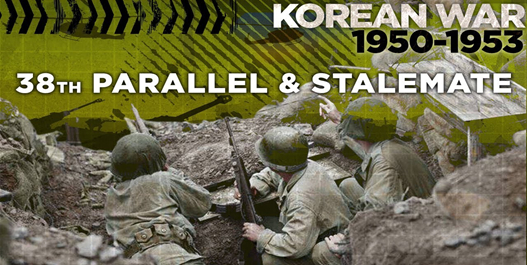
INTERNATIONAL CONFERENCE. UNITED NATIONS AND KOREAN WAR (1950-1953). POLITICS, WAR AND PEACE

- Policy of the UN for Korean War: The involvement of the United Nations (UN) to the Korean War was significant for South Korea (positively) and North Korea (negatively). How was the decision made so early? Who was involved in the process? How was the policy implemented internationally?
- Human Movements, POWs and Refugees: The war directly impacted the relocation of the local people (6.3 million).The waralso caused many POWs and refugees. How was the geographical landscape of the human movements? What was the situation of refugees? Were the POWs treated fairly?
- War Strategy and Battles: The various war strategies were applied at the battlers of the Korean War between the army, navy (the marine corps) and air force of China, Russia, UN, North and South Koreas. How was the strategy changed? What was the turning point for each other? Which battles were significant? What about the condition of retrogression?
- Narratives of Victims and Casualties (Soldiers and families): The war generated many victims (death and wound) which affected the emotional and mental condition of family members. What was the story of individual involvement? How do they remember the East Asian war? What is the post-war life of soldiers? Do they have any story in relation with Korean people?
- Human Rights and Welfare (medicine, orphans, and education): Under the military situation of the Korea war, there were the various activities of international, public and NGO organisations in the sphere of human rights. How was the medical service provided? How were orphans managed? Was any activity of education continued?
- Theory and Method in Unification and Peace Process: Since the Korean War has been 70 years and remained as an unfinished war, what kind of theory or method can be adopted for the development of Korean Unification? How can the peace process take a place for the future of both Koreas?
- Paper title
- Nominated stream
- Name and affiliation
- Contact details (email)
- Abstract of 150-200 words
- Biography of 80 words highlighting teaching and research interests and publications (3-4 title and year only).
- Proposal deadline: 15 June 2022
- Notification: 30 July 2022
- Registrations open: 05 August 2022
- Registrations close: 30 August 2022
- Conference: 21-24 October 2022
- Full-time scholar: $300
- Student/ part-time and unwaged scholar/ audience: $250
- Local Korean scholar: $200
- Publishers and Bookshops: $400
CFP: CULTURE-BOUND SYNDROMES IN POPULAR CULTURE
- Zou huo ru mo (China)
- Dhat syndrome (India)
- Hikikomori (Japan) Already taken!
- Taijin Kyofusho (Japan) Already taken!
- Hwabyeong (South Korea)
- Pa-leng (Taiwan)
- Lanti (Philippines)
- Latah (Indonesia, Malaysia)
- Amok (Malaysia)
- Koro (Singapore)
- Locura
- Mal de pelea
- Nervios
- Susto
- Saladera (Peruvian Amazon)
- Windigo Psychosis (Native American)
- Zar (Israel, Ethiopia)
- Ufufuyane, Saka (Kenya)
- Voodoo death (Haiti, Africa, Australia)
CFP: THE HOLOCAUST AND ASIA: REFUGEES, MEMORY, AND MATERIAL CULTURE
The Holocaust and Asia: Refugees, Memory, and Material Culture
March 28–Wednesday, April 6, 2022
Application deadline: Monday, February 1, 2021
The Jack, Joseph and Morton Mandel Center for Advanced Holocaust Studies at the United States Holocaust Memorial Museum invites applications for a research workshop entitled The Holocaust and Asia: Refugees, Memory, and Material Culture. The Mandel Center will co-convene this workshop with Kimberly Cheng, Skirball Department of Hebrew and Judaic Studies, New York University, and Ran Zwigenberg, Asian Studies, History and Jewish Studies, Pennsylvania State University. The workshop will take place at the United States Holocaust Memorial Museum’s David and Fela Shapell Family Collections, Conservation and Research Center.
The workshop is scheduled for March 28–April 6, 2022. In the event that it is impossible to convene during those dates due to the Coronavirus pandemic, the workshop will be held in a hybrid format consisting of a series of short online sessions in advance of an in-person program convened at the Museum to be scheduled in the Summer of 2022.
In recent decades, the Holocaust has occupied an increasingly prominent place in Asian cultures of memory. Chinese intellectuals have called the Cultural Revolution their “Holocaust,” and both China and Japan have found and commemorated their own “Schindlers” (Ho Feng-Shan and Sugihara Chiune). Partition refugees in India/Pakistan have compared themselves to Jewish refugees, and memory activists across Asia have invoked Holocaust analogies in the region’s never-ending history wars. Yet the Holocaust’s impact on Asia was not just cultural. Many Asians witnessed the Holocaust firsthand, and tens of thousands of Jewish refugees fled through Asia. In Asia, these Jewish refugees appeared as poor white Europeans, challenging Asians’ conceptions both of the figure of the Jew and of the white man; both for Jews and Asians, their encounters with one another as racial others brought stark questions of identity, race, racism, gender, class, and colonial entanglements to the fore. Whether in the realm of exchange between refugees and local populations, or in mutual learning about the place of artifacts in commemoration, the circulation of material culture only served to deepen these divides.
Surveying the Holocaust-related myths and historical realities in Asia writ large (from China and Japan through Central Asia to Iran), this workshop explores Jewish and Asian involvement in the Holocaust and its memory. Our workshop examines the limits of the term “Holocaust” and its applicability across histories and cultures to account for the multifaceted ways the tragedy has reverberated beyond Europe. In doing so, we intend to delimit the existence of an Asian sub-field or an “Asian turn” within Holocaust studies.
To identify the main lines of inquiry of this burgeoning field, the workshop will consist of presentations and roundtable discussions led by participants along three thematic tracks: 1) the experiences of refugees, 2) Asian cultures of memory, and 3) material culture. Daily sessions will be led by participants, as well as discussions with Museum staff and research in the Museum’s collections. The workshop will be conducted in English.
How to Apply
Applications are welcome from scholars affiliated with universities, research institutions, or memorial sites and in any relevant academic discipline, including anthropology, archeology, art history, Asian studies, Eastern European and Eurasian studies, genocide studies, geography, history, Jewish studies, law, literature, Middle Eastern studies, philosophy, political science, psychology, sociology, religion, Romani studies, and others. Applications will be accepted from scholars at all levels of their careers, from PhD candidates to senior faculty. Scholars working in Asian academies, as well as scholars from underrepresented backgrounds in the field, are particularly encouraged to apply.
The Mandel Center will reimburse the costs of round-trip economy-class air tickets to/from the Washington, DC metro area, and related incidental expenses, up to a maximum reimbursable amount calculated by home institution location, which will be distributed within 6–8 weeks of the workshop’s conclusion. The Mandel Center will also provide hotel accommodation for the duration of the workshop. Participants are required to attend the full duration of the workshop.
The deadline for receipt of applications is Monday, February 1, 2021. Applications must include an abstract of no more than 300 words outlining the specific project that the applicant is working on, plans to research, and is prepared to present during the program; and a short bio. The application form.
Museum Resources
The Museum’s National Institute for Holocaust Documentation houses an unparalleled repository of Holocaust evidence that documents the fate of victims, survivors, rescuers, liberators, and others. The Museum’s resources include approximately 110 million pages of Holocaust-related archival documentation; library resources in over 60 languages; hundreds of thousands of oral history, film, photo, art, artifacts, and memoir collections; and the Holocaust Survivors and Victims Database, which contains about 11.5 million name records and over 44,000 list records. In addition, the Museum possesses the holdings of the International Tracing Service (ITS), which contains more than 200 million digitized pages with information on the fates of 17.5 million people who were subject to incarceration, forced labor, and displacement as a result of World War II. Many of these records have not been examined by scholars, offering unprecedented opportunities to advance the field of Holocaust and genocide studies.
The Museum’s Asia-related collections include:
- Collections from Kazakhstan, Kyrgyzstan, Uzbekistan, the Polish government in exile, and the Anders Army related to the fate of Soviet and Eastern European Jewish evacuees in Central Asia.
- Collections from the Ministry of Foreign Affairs of Japan and the Koreshige Inuzuka Papers
- Records of various refugee and immigrant aid organizations, such as the Central Information Bureau for Jewish War Sufferers in the Far East and the Far Eastern Jewish Central Information Bureau (DALJEWCIB) Harbin-Shanghai
- Records from the Shanghai Municipal Archives, including those related to Jewish refugee emigration
- Records from the British government’s India Office
- Records from the United Nations Relief and Rehabilitation Administration's China Office, India Mission, Philippine Mission, and Southwest Pacific Area Office
- Photos from Central Asia, Southeast Asia, China, and Japan
- Oral histories of survivors and refugees who lived in the Dutch East Indies, India, the Philippines, China, and Japan
- Numerous small and mid-size personal collections of letters, memoirs, photos and personal documents, oral history interviews, and artifacts of Jewish refugees in Central, South, and East Asia, such as the Sara Kupinski Cohen Collection, the Adolphe and Raechel Dikker Collection, the Nacht Family Papers, the Siegmund Sobel Collection, the Joan Kent Finkelstein Collection, the William Weeg Family Papers, the Anatole Ponevejsky Papers, and the Pilpel Family Papers, among many others
Participants will have access to both the Museum’s downtown campus and the David and Fela Shapell Family Collections, Conservation and Research Center. To search the Museum’s collections, please visit the collections catalog.
For More Information
Direct questions to Krista Hegburg, PhD, Senior Program Officer, International Academic Programs Division, Jack, Joseph and Morton Mandel Center for Advanced Holocaust Studies, at khegburg@ushmm.org.
This Call for Applications.
COURSE: POLICY LESSONS FROM SOUTH KOREA'S DEVELOPMENT, WORLD BANK GROUP.
Policy Lessons from South Korea's Development,
Learn about South Korea’s remarkable transformation from a low- to high-income economy in only three decades.
About this course
South Korea presents a compelling story of economic growth. It’s one of few countries that made the transition from a resource-poor, low-income nation to a high-income economy in only three decades. It offers a model for developing countries and in this MOOC, leading experts will explain how South Korea achieved this outcome by implementing an export-led industrial strategy.
This course examines South Korea’s past developmental experience as well as its current strategy and policy initiatives to overcome global and domestic challenges, and sustain economic growth into the 21st century. You’ll have an opportunity to consider and discuss institutional and policy lessons applicable to the developmental challenges facing your own countries.
The course will be of interest to all those wanting to learn how South Korea was transformed into a high-income, with the help of a highly skilled workforce, and the development of high-end manufacturing and services sectors. Also of great interest is Korea’s creation of a futuristic city, Songdo, equipped with smart and green technologies. This MOOC will be of particular interest to policymakers involved in economic development.
The course has been developed by the World Bank Group in collaboration with Korea Development Institute, and is taught by prominent representatives of academic and research institutions in South Korea and the United States.
Details:
- Length: 4 Weeks
- Price: FREE. Add a Verified Certificate for €4
- Institution: WBGx
- Subject: Economics & Finance
- Level: Intermediate
- Language: English
- Video Transcript: English
- Course Type: Instructor-led on a course schedule
Prerequisites:
Familiarly with basic economics concepts would be helpful but is not required.
CFP: HISTORIC AND CURRENT PERSPECTIVES ON INTERNATIONAL ADOPTION AND COLD WAR MATERNALISM IN THE US
"LA TRANSFORMACIÓN DEL SISTEMA INTERNACIONAL EN ASIA-PACÍFICO", CLUB FINANCIERO GÉNOVA
CFP: 2019 IM CONFERENCE OF KOREAN CHRISTIANITY
- Christianity in North(ern) Korea
- Colonialism and Christianity, 1910-1945, and
- Christianity, Nation Building, and US-Korea Relations, 1945-1965.