Mostrando entradas con la etiqueta estudios asiáticos. Mostrar todas las entradas

ÚLTIMAS PUBLICACIONES ACADÉMICAS 2023 (III)


Continuamos con nuestra revisión de los libros académicos relacionados con los estudios coreanos que se han publicado a lo largo del segundo trimestre de 2023. Un listado centrado en diversas y muy variadas áreas dentro de los campos de las Ciencias Sociales y Humanidades, puestos ya a disposición de todos por las diferentes editoriales que facilitamos a continuación:

TRANSNATIONAL MEMORIES IN EAST ASIA: ACTS OF REMEMBERING THROUGH MEDIA AND VISUAL CULTURE


Memorial Sites. Acts of remembering through media and visual culture:

Transnational Memories in East Asia


TRANSNATIONAL MEMORY OF THE SINO-JAPANESE WAR

Discussant: Michael Tsang (Birkbeck, University of London)

  • "Reading the Transformations of Chinese War of Resistance Museums in the Xi Jinping Era through the Visual Analysis"

Markéta Bajgerová Verly is a PhD student in the ERC project Globalized Memorial Museums at the Institute of Culture Studies and Theatre HistoryAustrian Academy of Science, and at the University of Vienna. Her research focuses on War of Resistance against Japan museums in contemporary China. In 2020, she obtained an MA degree in China Studies at the Yenching Academy of Peking University. In China, she led a Dean’s Grant project mapping 30 museums across China devoted to the memory of the War of Resistance and studied its memory politics. This project informed her MA thesis analysing the impact of the discourse on the museum’s domestic audience as well as her current PhD research. She holds an undergraduate degree from the University of Glasgow in Politics and History. During her early studies, she focused on politics of sacrifice and the affective turn in politics and was a research associate at the Institute of International Relations in Prague.

  • "Investigating Photography Albums of Japanese Soldiers in North-East China. Methodological and Epistemological Challenges"

Jasmin Ruckert is a PhD student at the Institute for Modern Japanese Studies at Heinrich Heine University Düsseldorf. She has studied in Vienna and Paris (Paris VII) and completed two master’s degrees in Gender Studies and Japanese Studies at the University of Vienna in 2017 and 2018. In her master theses, she investigated visual representations of gender and of queerness in Japanese terebi dorama. During her employment in a research-project on Japanese propaganda funded by the German Research Foundation (DFG) her academic focus shifted towards historical media and the employment of fascist aesthetics and structuring of media politics in fascist empires. She is currently involved in publishing a volume entitled ‘Gendering Fascism’ (Brill 2024) together with Prof. Andrea Germer (Heinrich Heine University) on transnational entanglements and gendered dynamics in fascist movements and regimes of the early to mid 20th century. In her role as a lecturer at Heinrich Heine University, she has given courses on ‘Photography in Japan’, ‘Methodology in Transcultural Studies’ and on the history of Japanese-Chinese relations. Together with undergraduate students from her cultural studies course on ‘Representations of War’, she recently organised an exhibition on wartime photography.


MEMORIAL SITES IN KOREA


  • "The Korean War through Women’s Eyes: Sinchon Museum of American War Atrocities"

Suzy Kim is a historian and author of the award-winning Everyday Life in the North Korean Revolution, 1945-1950 (Cornell 2013). Her work has appeared in positions: asia critique, Asia-Pacific Journal, Cross-Currents, Comparative Studies in Society and History, and Gender & History. She holds a PhD from the University of Chicago, and teaches at Rutgers, the State University of New Jersey in New Brunswick, USA. Her newest book is Among Women across Worlds: North Korea in the Global Cold War (Cornell 2023).

  • "Jeju 4.3 – Postmemory Aesthetics of Museal Images"

Hyunseon Lee, Ph.D. habil., is a London based film, media and literary scholar. She is a Privat-Dozent in Media Studies and Modern German Literature at the Department of German, University of Siegen, and a Research Associate at Department of East Asian Languages and Cultures, and Centre for Creative Industries, Media and Screen Studies, SOASUniversity of London. She has lectured and published widely in the fields of German and comparative literature, film, and media studies, and held various scholarships and fellowships at Yonsei University and Seoul National University, Columbia University in New York City, and Chuo University in Tokyo, and at the Institute of Germanic & Romance Studies/ School of Advanced Study, University of London. She is author of the books Metamorphosen der Madame Butterfly. Interkulturelle Liebschaften zwischen Literatur, Oper und Film [Metamorphosis of Madame Butterfly. Intercultural Love affairs between Literature, Opera and Film] (Heidelberg: University Press Winter, 2020), Geständniszwang und ‘Wahrheit des Charakters’ in der Literatur der DDR. Diskursanalytische Fallstudien [Compulsion to Confess and 'Truth of Character’ in the Literature of the GDR. Discourse Analytical Case Studies] (Stuttgart: J.B. Metzler, 2000), Günter de Bruyn – Christoph Hein – Heiner Müller. 3 Interviews (Siegen, MuK 95/96) as well as numerous articles on the topics of German literature, East Asian and Korean peninsula cinema, gender, exoticism, popular culture and media aesthetics. She is co-editor of Murderesses (2013), Akira Kurosawa and His Time (2005), and Opera, Exoticism and Visual Culture (2015), and solo editor of two books Korean Film and Festivals: Global Transcultural flows (Oxfordshire: Routledge, 2022) and Korean Film and History (Oxfordshire: Routledge, 2023/forthcoming). She is currently researching war, gender, and memory in European and East Asian cultures, with a focus on K-culture as well as North and South Korean cinema.

Seminar director: Dr. Marcos Centeno (University of Valencia. Birkbeck, University of London)


MORE INFORMATION
  • Date: Thursday 30th March, 3-5pm UK time (4-6pm CET, European Central Time)
  • Seminar online. Registration required.

ÚLTIMAS PUBLICACIONES ACADÉMICAS 2023 (I)


Retomamos un año más nuestros listados con las últimas novedades académicas que han visto la luz en el último trimestre de 2022. Avances publicados en formato libro dentro del ámbito de los Estudios Coreanos, abordadod desde diferentes disciplinas dentro de las ciencias y las humanidades. Todas ellas ya disponibles para todos a través de las múltiples editoriales que también facilitamos a continuación:

ÚLTIMAS PUBLICACIONES ACADÉMICAS 2022 (I)


Una vez más, ofrecemos las últimas novedades académicas que han visto la luz en este segundo trimestre de 2022 entre las editoriales académicas de mayor prestigio en el mundo. Con los estudios coreanos como principal eje común, el siguiente listado de libros ofrecen enfoques multidisciplinares dentro de las Ciencias Sociales y las Humanidades. La siguiente selección ya se encuentra disponible para su compra: 

CFP: SOUTH KOREAN SPECULATIVE FICTION. THE JOURNAL OF THE FANTASTIC IN THE ARTS


Newtrospection: Reverse-Engineering Modernity in South Korean Speculative Fiction


The Journal of the Fantastic in the Arts (JFA), published since 1988, is an interdisciplinary journal devoted to the study of the fantastic in literature, art, drama, film, and popular media. Published three times per year by the International Association for the Fantastic in the Arts, JFA’s articles are fully refereed, indexed in the MLA International Bibliography, and searchable in JSTOR. The editorial collective of JFA is currently working to make the journal indexed in SCOPUS and A&HCI as well. In early 2023 JFA plans to publish its first focused issue dedicated to South Korean science fiction and fantasy.

South Korean speculative fiction has a long and rich yet also conflicted history that spans over a century. Building on the legacy of the fantastic in premodern literature while also struggling with colonial drives toward the inculcation of science-technology (kwahak kisul – a compound term devised and systematically promoted as a state-led initiative on industrial development and lifestyle management), creators and readers of Korean science fiction have sought diverse pathways to negotiate the anxiety of influence through critical reappropriation. Taeguek Hakbo’s publication of Jules Verne’s 20,000 Leagues under the Sea (trans. 1907) for instance introduced and framed modern technology as the momentum of progress, whereas Kim Dong-yin’s short story “Dr. K’s Research” (1929) highlighted the limits of a scientific frame of reference through irony. Despite pressures to focus on the problems of the here and now in the form of critical realism, speculative narratives persisted across the mediasphere throughout the turmoil of the Korean War and compressed development; creature/cult/horror films served as an outlet for quirky imaginaries in the ‘60s~’70s, while the comics magazine culture offered a fertile ground for science fiction narratives throughout the ‘80s~early ’90s. The film industry has also embraced speculative tropes as inspiration for hybrid aesthetics after an initial period of struggle (marked by a slew of unsuccessful blockbusters in the early 2000s); television dramas, streaming media, and webtoons are actively embracing the genre as the source of creative momentum; and videogames, in particular, are thriving in the land of the fantastic. In the domain of written literature, fantasy spearheaded the break from the longstanding tradition of critical realism in pace with South Korea’s economic and political stabilization in the ‘90s, and science fiction has become the nursery of feminist breakthroughs to attract global attention over the past decade – an ever-peculiar (yet all the more welcome) state of affairs given the predominantly masculine vector of the genre’s history, paired with the patriarchic underpinning of the kwahak kisul paradigm.

Even as megahit productions such as Snowpiercer (2013), Train to Busan (2016), Space Sweepers (2021), The Silent Sea (2021), and All of Us Are Dead (2022) continue to draw a global viewership, scholarship on South Korean speculative fiction within anglophone academia has been extremely sparse. To address this gap, the editors of this focused JFA issue shed timely and much-needed light on the subject across diverse media. The goal is not to catalogue the genre’s history in South Korea; rather, focus will be laid upon how South Korean speculative fiction writers and creators reverse-engineer the Western concept of modernity through reappropriative maneuvers, taking a deep-dive into the socio-cultural and historical frameworks as innovative aesthetic and discursive ventures. Hence the title, Newtrospection. Newtro refers to a new aesthetic trend in South Korea, which involves reviving and appreciating aesthetic trends from the past. The distinction between retro and newtro lies in that whereas the former veers toward nostalgia in its texture of appreciation, and as such signals contextual significance, the latter is more about challenging existing notions of the hip and/or good in its reconfiguration of trendiness, subverting the idea that the old is passé while disavowing associations between futurity and newness with sleek technicity. Identifying such tendencies in South Korean speculative fiction, the editors believe that the manner in which recent works own and thereby recontextualize longstanding metrics of desirability effectively demonstrate a drive to reverse-engineer the core tenets of anthropocentric, patriarchic, racialized, and colonial paradigms of science and technology.

In addition to scholarly essays on literary texts, the editors also welcome papers about all forms of creative work, including translations, films, television dramas, and new media in the genre of speculative fiction created by South Korean artists or written in Korean. Themes of interest include, but are not limited to:
  • Comparative definitions, conceptualizations, and historicizations of science, technology, and sociotechnical imaginaries 
  • Modernity, premodernity, and postmodernity 
  • Humanism, posthumanism, and transhumanism 
  • Retrospection, memory, and the newtro
  • Nationalism, coloniality, Orientalism, Occidentalism, and Techno-Orientalism
  • Viruses, microorganisms, zombies, monsters, animals, plants, nonhumans, and sentient beings
  • Robots, artificial intelligence, cyborgs, genetics, and bioengineering
  • Ghosts, goblins, gods, demigods, myth, folklore, and supernatural beings 
The length of articles generally varies from 5,000 to 9,000 words and ranges from 20 to 30 pages. Please send a title and a 400-word abstract to guest editors Haerin Shin, Korea University (helenshin@stanford.kr) and Sang-Keun Yoo, UC Riverside (syoo015@ucr.edu) by May 31, 2022. Authors of accepted proposals will be contacted soon thereafter and asked to submit full papers by August 31, 2022. All papers will be subject to blind peer review.
 

Call for Book Reviews
 
There is also several books available for review for The Journal of the Fantastic in the Arts. These reviews would be due August 31, 2022.  If you have a completed Master's degree or higher, one of these books is in your field of study, and you are committed to writing a review for us, please contact the guest editors at the above email addresses, noting your preferred title and your mailing address.  The reviews need to be between 500 and 1,000 words and documented in MLA style
 

Available Titles
  1. Readymade Bodhisattv
The Journal of Fantastic in the Arts is planning a focused issue on South Korean speculative fiction. The issue signals JFA's drive to broaden its horizon beyond anglophone SF as an ongoing initiative. The editors are excited to invite submissions - including original essays (across media) and book reviews. 
 
  
Contact Info:

Haerin (Helen) Shin, Korea University, helenshin@stanford.kr

Sang Keun Yoo, UC Riverside, syoo015@ucr.edu

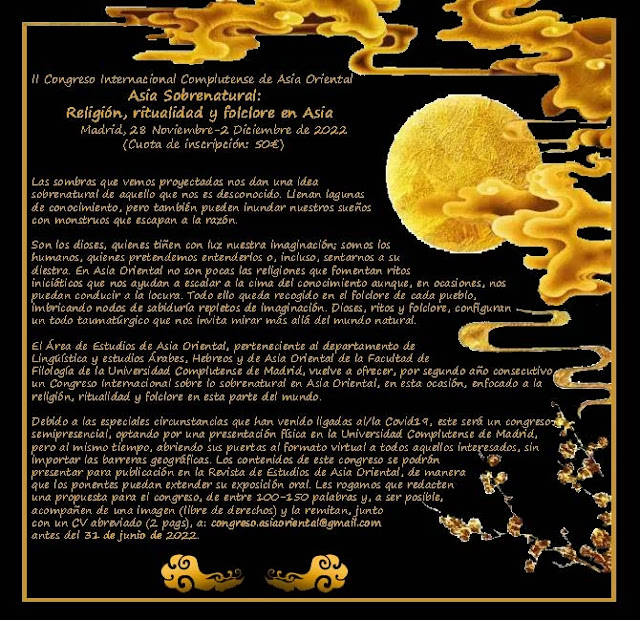
CFP: II CONGRESO INTERNACIONAL DE ASIA ORIENTAL. ASIA SOBRENATURAL: RELIGIÓN, RITUALIDAD Y FOLCLORE EN ASIA


Asia Sobrenatural: Religión, ritualidad y folclore en Asia

II Congreso Internacional Complutense de Asia Oriental

Madrid, 28 Noviembre-2 Diciembre de 2022


Las sombras que vemos proyectadas nos dan una idea sobrenatural de aquello que nos es desconocido. Llenan lagunas de conocimiento, pero también pueden inundar nuestros sueños con monstruos que escapan a la razón.

Son los dioses, quienes tiñen con luz nuestra imaginación; somos los humanos, quienes pretendemos entenderlos o, incluso, sentarnos a su diestra. En Asia Oriental no son pocas las religiones que fomentan ritos iniciáticos que nos ayudan a escalar a la cima del conocimiento aunque, en ocasiones, nos puedan conducir a la locura. Todo ello queda recogido en el folclore de cada pueblo, imbricando nodos de sabiduría repletos de imaginación. Dioses, ritos y folclore, configuran un todo taumatúrgico que nos invita mirar más allá del mundo natural.

El Área de Estudios de Asia Oriental, perteneciente al departamento de Lingüística y estudios Árabes, Hebreos y de Asia Oriental de la Facultad de Filología de la Universidad Complutense de Madrid, vuelve a ofrecer, por segundo año consecutivo, un Congreso Internacional sobre lo sobrenatural en Asia Oriental, en esta ocasión, enfocado a la religión, ritualidad y folclore en esta parte del mundo.

Debido a las especiales circunstancias que han venido ligadas al/la Covid19, este será un congreso semipresencial, optando por una presentación física en la Universidad Complutense de Madrid, pero al mismo tiempo, abriendo sus puertas al formato virtual a todos aquellos interesados, sin importar las barreras geográficas. Los contenidos de este congreso se podrán presentar para publicación en la Revista de Estudios de Asia Oriental, de manera que los ponentes puedan extender su exposición oral. Les rogamos que redacten una propuesta para el congreso, de entre 100-150 palabras y, a ser posible, acompañen de una imagen (libre de derechos) y la remitan, junto con un CV abreviado (2 pags) antes del 31 de junio de 2022, a:

congreso.asiaoriental@gmail.com

(Cuota de inscripción: 50€)


CFP: STATE AND SOCIETY IN ASIA: PAST AND PRESENT, NEW YORK CONFERENCE ON ASIAN STUDIES


State and Society in Asia: Past and Present,


October 7-8, 2022. Syracuse University


We invite submissions from scholars across all disciplines on all topics related to Asia and Asian Studies. We are particularly interested in topics related to our main theme: “State and Society in Asia: Past and Present.” In bringing scholarly perspectives to these current events, questions that interest us include: What historical legacies of the state persist in contemporary Asia? What roles do technology and urban development play in extending state power to unprecedented degrees? Conversely, how does a vacuum in state infrastructure in countries like Afghanistan create conditions for regime change? Can countries like Myanmar continue to isolate themselves and not suffer social and economic hardships? Contemporary artists, filmmakers, and environmental activists frequently challenge and critique these developments. How do regime changes unsettle and re-arrange key local and national cultural constituents and what impact do these changes have on environmental history, archaeology, and cultural heritage sites?

Submit your paper or panel abstract by June 15, 2022 here.

Send any questions to the conference chair: 

Prof. Gareth Fisher: gfisher@syr.edu

CFP: A PERVERT'S GUIDE TO CRITICAL POSTMEDIA STUDIES IN KOREA


A Pervert’s Guide to Critical Postmedia Studies in Korea

China Media Research Special Section


This special section of China Media Research invites scholars from a broad range of disciplines and methodologies to submit manuscripts on the theme of A Pervert’s Guide to Critical Postmedia Studies in Korea.

In this special issue on critical postmedia studies in Korea, playfully entitled A Pervert’s Guide to Korea, our intention is to theorize the “eruption” or flooding of media which has recently emerged in the Korean context. From a postmedia perspective, our special issue aims to comprehensively diagnose and understand social and psychical phenomena that occur in the flooding media situation across Korea. It is clear that the archipelago has witnessed rapid societal change due to the development of new technologies and the transformation of the industrial base but the psychic changes are in some ways difficult to fathom and find in other countries. The psychical effects of this need to be understood as the changes and effects are fundamental to the crisis of desire in the schizzed archipelago. Of course, as the social demand for convergence is high, it cannot be said that there are no studies on the relationship between technology and the humanities with a view to postmedia in Korea but as the theoretical investigation to synthesize these studies is relatively insufficient our critical postmedia special issue will comprehensively analyse the aspects of informatization that are taking place in Korea as a major aspect of “media flooding”.

We are concerned with the question of contact and the plight of the hikikomori or social recluse (引きこもりhikikomori – [eundoonhyeong oiteollie - 은둔형 외톨이]・[히키코모리・hikikomoli] - in the Korean context and are thinking about the idea of contact as a kind of skin, an epidermis between sense and nonsense, contact and contactlessness. Is the hikikomori the expression of a kind of contactlessness or what one might call a deadly ipseity of desire? If so, what has happened to desire? Do we abide in an indeterminate paralysed contact zone of mediatic social rules where former rules no longer make sense? If so, the contact zone becomes a kind of non-place, atopia, a state of contactlessness. Where is the desire for contact in Korea and what does it mean to resist contact, to be without contact, to be without desire? What does it mean to risk contact, to risk being tactile with the other, to risk affirming one’s desires? We are making the case for a chaosmosis of skin and contact and shall use several concepts to think about the phenomenological experience of crisis as a zone of indeterminacy between contact and contactlessness. We desperately want to know what has happened to desire, to its promise and possibility and why it is so difficult to anticipate or forecast what is to come. How can we account for the contemporary vibrations, flows, schizzes, and, importantly, knots of desire? Why so much perversion of pleasure and desire? How can we write a schizoanalysis and ecosophy of Korea focused on the critical postmedia analysis of Korea’s media terrain? Where is the revolutionary potential of madness in Korea when the schizo has become an “autistic rag” - separated from the real and cut off from life? What has caused the drop in intensity to the BwO of the autistic? Is autism the “exceptional, marginal reaction to the acceleration of the info-sphere”? Our intention is to critical contest the psychopathologic litany of semiocapitalism - exhaustion, burnout, anxiety, ADHD, panic, depression, and in extremis suicide – to look beyond the prevalent sense of mental implosion and “chaosmic spasms” which loom on the horizon of Korea.

What is the “psychic tourniquet” acting upon the Korean socius and what form of “existential gangrene” infests the Korean BwO? What is the nature of the “truly immanent dimension” of the Korean unconscious?” Contra Han Byung-Chul, what explosive and unusual concepts are available to us to rethink the question of desire in Korean society? What interrupts the process of schizophrenic desire in Korea and what is the mass psychopolitics of Korean capitalism?

We shall address concepts such as flooding, eruption, flow, streaming, inhibition, vegetative stasis, to understand the hikikomori problem. Why is there such a specific shutting off from the world which we find in many Asian countries such as Korea and Japan. If there is such a thing, what is the nature of the Korean unconscious and how is it connected with “ontological security,” with violence, with the loss of eros? Is the unconscious structured like the Internet, like the smartphone? If so, how has the smartphone become a new body part in the Korean context? How does desire continue to desire its own repression? How is desire tied to the flows of capitalism? What is the specific nature of Korean capitalism? How is pleasure and desire imperiled by burnout, fatigue, addiction, intoxication with technology, stress, anxiety as well as shame and guilt? What is the BwO of Korean youth? What therapeutic practices are available to the social recluse? To what extent does the sedentary territory of the hikikomori grant us exemplary access to the fundamental shifts in affectivity and corporeal organization produced and commanded by technology and semiocapitalism in the Korean context?

CMR invites scholars to submit their original manuscripts that investigate the above provocations. In addition to philosophical and theoretical manuscripts, this special section also welcomes rigorous media-related case studies that report on Korea. Emerging and experimental research approaches from film studies, aesthetics, medical humanities and the social sciences are strongly encouraged.

Submissions must not have been previously published nor be under consideration by another publication. An extended abstract (up to 1000 words) must be received by June 8, 2022, or a complete paper received by October 8, 2022.

Manuscripts should be prepared in accordance with the APA publication manual (6th edition) and should not exceed 8,000 words including charts, figures, references, and tables. All manuscripts will undergo the standard blind review, and the authors will be notified of the final acceptance/rejection decision within three months of the submission. CMR is a quarterly journal, which publishes both print and online versions.

Sample styleguide is here.

Send your questions and submissions to the CMR special section guest editors, Prof Dr Joff P. N Bradley, Prof Dr Woosung Kang, Prof Dr Alex Taek-Gwang Lee.

Contact Joff P. N Bradley in the first instance joff@main.teikyo-u.ac.jp


Contact Info:

​Bradley Joff P.N. Professor


192-0395 359 Otsuka, Hachioji-shi, Tokyo

Office: + 81-42-678-3493

Email: joff@main.teikyo-u.ac.jp

CFP: "MAPPING ASIA: CARTOGRAPHY AND THE CONSTRUCTION OF TERRITORIALITY", CONFERENCE


Mapping Asia: Cartography and the Construction of Territoriality”, Conference

Centre for Transcultural Studies, Gotha Research Campus, Erfurt University, Germany

24th–25th November 2022


This conference will explore cartography and the construction and contestation of territoriality in Asia from the late eighteenth to the twentieth century. In particular we seek to answer the question of how ideas of territoriality were cartographically produced, circulated and interpreted within Asia and between Europe and Asia.

The conference is part of the project "Cartographies of Africa and Asia (1800–1945). A Project for the Digitization of Maps of the Perthes Collection Gotha” (KarAfAs). KarAfAs is a co-authored endeavour of the Centre for Transcultural Studies at Gotha and the Perthes Collection of the Gotha Research Library, funded by the German Federal Ministry of Education and Research. By digitising the maps of the Perthes collection in Gotha, we intend to inspire future projects which see questions of territoriality and spatiality in a fresh light, utilising the source material held at the Perthes Collection. Participants will be invited to a tour of the highlights of the collection’s cartographic material on Asia.

We invite papers which address any of the following themes:
  • The circulation of cartographic knowledge and the territorial imagination
  • The role of Asian and European cartography in nation and state formation
  • Cartography and the making of colonial and post-colonial borderlands
  • Mapping and counter-mapping
  • The construction of the idea of ‘Asia’ and its boundaries
We welcome papers written on any geographical area in Asia which deal with the intersection of cartography and territoriality from the eighteenth to the twentieth century.

We especially encourage applications from groups underrepresented in the academy. We can offer small grants to reimburse the costs of accommodation and regional travel, with priority given to early career scholars.

Please submit abstracts (in English, up to a maximum of 250 words) together with a short bio to frances.omorchoe@uni-erfurt.de by Sunday 17th April. We will inform applicants of the outcome of their applications by the end of April.

Send inquiries to Claudia Berger at claudia.berger@uni-erfurt.de or Frances O’Morchoe at frances.omorchoe@uni-erfurt.de.


CONVOCATORIA DEL PROGRAMA DE BECAS 2022 DE LA ACADEMIA DE ESTUDIOS COREANOS (AKS)

Convocatoria del Programa de Becas 2022


La Academia de Estudios Coreanos (AKS) abre la convocatoria del Programa de Becas 2022 (2º Semestre) de estudios de postgrado o doctorado para estudiantes internacionales. Para aquellos solicitantes interesados en el Programa 2022 de AKS, lea atentamente la siguiente información:
1. Información general
  • El programa AKS ofrece ayudas para estudios de Máster o Doctorado relacionados con Corea del Sur o la sociológia científica de la humanidad.
  • Las ayudas incluyen el importe de los créditos matriculados durante el periodo de estudios (Máster: 2 años, Doctorado: 3 años).
  • Casi un 70 % de los estudiantes internacionales se benefician de las Becas del Gobierno con una ayuda mensual de 750.000 KRW (550€ aprox.) durante un año (renovable tras evaluación).​

2. Requisitos:
  • Nacionalidad: Podrán participar en el programa de becas aquellos estudiantes que posean una nacionalidad distinta de la coreana o los coreanos que residen fuera de Corea del Sur.
  • Requisito académico: Estar en posesión del título de Graduado y/o Máster
  • Idioma:
    • Solicitantes para los estudios sobre la cultura y sociedad coreana: 
      • un nivel de inglés certificado en algunos de los siguientes programas: TOEFL iBT (superior a 80), IELTS Academic Module (superior a 6.5), o TEPS (superior a 301). Los certificados deben haberse obtenido en los últimos dos años. 
      •  No se requiere el certificado TOPIK.
    • Solicitantes para otros estudios: 
      • El certificado de TOPIK con un nivel igual o superior al nivel 4

3. Plazo de presentación de solicitudes

Desde el viernes 18 de marzo de 2022 hasta el viernes 1 de abril de 2022 ambos inclusive

4. Contacto
  • Teléfono: +82-31-730-8183
※ ​IMPORTANTE : Se pueden consultar todos los detalles del programa de ayudas AKS en el archivo adjunto que contiene la guía.

SIMPOSIO INTERNACIONAL MUJERES, IGUALDAD Y ESCLAVITUD EN COREA, UNIVERSIDAD DE MÁLAGA


Simposio Internacional «Mujeres, igualdad y esclavitud en Corea»,


El Área de Estudios de Asia Oriental-Departamento de Ciencias Históricas de la UMA organiza el Simposio Internacional «Mujeres, igualdad y esclavitud en Corea» los próximos días 22 y 23 de marzo, a celebrar en la Sala de Juntas «Manuel Rodríguez de Berlanga» de la Facultad de Filosofía y Letras y en el hall de la Facultad de Ciencias de la Educación.

Este Simposio contará con seis conferencias sobre género y esclavitud en Corea impartidas por expertos en dichas materias, procedentes de Corea del Sur de Incheon National University, Sogang University y la Academy of Korean Studies, así como de la propia la Universidad de Málaga.

Además en el marco del evento, el día 22 de marzo tendrá lugar la inauguración de la exposición de pósteres científicos de la «Red Temática de Mujeres de Asia Oriental: Corea, China y Japón» en el Hall de la Facultad de Ciencias de la Educación, en la que participan profesores expertos en la materia de diferentes universidades públicas de España. La inauguración se acompañará de la representación “Sopa de mujer” de la compañía Mu Teatro a las 13.00h. El Simposio finalizará el día 23 de marzo a las 13.30h con una representación de «Juegos» por parte de los estudiantes del Grado en Estudios de Asia Oriental bajo la dirección de la prof. Eun Kyung Kang en los exteriores de la Facultad de Filosofía y Letras.

Esta actividad se ha organizado en el marco de los «Path to equality: Korean Studies Network on inclusiveness» del Ministerio de Educación de Corea (AKS-2021-INC-2250002) y «ASIA-SLAVES El camino hacia la libertad en el periodo Joseon en Corea: Esclavitud y abolicionismo en el contexto de Asia Oriental» del Ministerio de Ciencia e Innovación de España (PID2020-116910GB-I00) y cuenta con financiación del I Plan Propio de Investigación Transferencia y Divulgación.

Puedes descargar el programa aquí.


CORNELL EAST ASIA PROGRAM 2022-2023 LB KOREAN STUDIES RESEARCH SCHOLARS


Cornell East Asia Program 2022-2023 LB Korean Studies Research Scholars

Cornell University, East Asia Program


Ubicación: New York, Estados Unidos

Posición: Becario de doctorado, becario, becario postdoctoral


The Cornell East Asia Program está aceptando solicitudes para una beca de investigación posdoctoral o predoctoral en residencia en Cornell (Campus de Ithaca) para el año académico 2022-2023. Los candidatos a doctorado avanzado y los recién graduados de doctorado cuya investigación esté relacionada con Corea pueden solicitar esta residencia de investigación no docente. La fecha límite de solicitud es el 11 de febrero de 2022.

El programa de investigación LB Korean Studies Research Scholars, dentro del Programa de Asia Oriental y el Centro Mario Einaudi de Estudios Internacionales de la Universidad de Cornell, tiene como objetivo cultivar nuevas colaboraciones que promuevan la erudición, la difusión de conocimientos, la enseñanza, la divulgación y el compromiso con el público en general para una comprensión más profunda de Corea en el mundo contemporáneo. El programa está abierto a académicos cuya investigación y enseñanza se centre en Corea, especialmente con una perspectiva comparativa, global y/o interdisciplinaria.

Los becarios de investigación de estudios coreanos de LB pueden tener formación en cualquier disciplina, así como llevar a cabo investigaciones interdisciplinarias que trasciendan los límites disciplinarios tradicionales. Además de los campos más tradicionales de los estudios coreanos, prevemos trabajos centrados en Corea en áreas como STEM, salud pública, planificación urbana, arquitectura y otras. La selección se basará en el potencial de la investigación del candidato para cultivar el diálogo y fomentar la colaboración entre disciplinas académicas, así como integrar, sintetizar y construir sobre las contribuciones disciplinarias existentes a la investigación de los estudios coreanos, en sentido amplio. Los becarios trabajarán en el Programa de Asia Oriental y en el Centro Einaudi de Estudios Internacionales, así como en colaboración con mentores y compañeros de Cornell.


Rol:

Los becarios se unirán a un centro interdisciplinario dinámico que reúne una profunda experiencia académica con amplias preocupaciones globales interdisciplinarias. Los becarios se beneficiarán de la formación y la tutoría en materia de publicaciones académicas y becas públicas al tiempo que contribuyen a la visión del Programa de Asia Oriental de hacer avanzar el estudio interdisciplinario de Corea. Organizarán la programación (como eventos pedagógicos y de investigación y/o coloquios), se coordinarán con el profesorado y los estudiantes, identificarán y se pondrán en contacto con socios globales y de la comunidad, y apoyarán al equipo de comunicaciones para difundir la investigación y los eventos de la iniciativa. Los becarios dedicarán aproximadamente el 50% de su tiempo a la investigación y el 50% a la iniciativa LB KSRS.


Posición disponible:
  • Becario visitante postdoctoral, o
  • Becario visitante predoctoral
El becario de investigación de estudios coreanos de LB puede ser un becario visitante posdoctoral (dentro de los 5 años posteriores a la concesión del doctorado) o un candidato al doctorado en una etapa avanzada de su doctorado (terminando su disertación). Estamos interesados en candidatos procedentes de programas de doctorado fuera de Norteamérica, así como de los Estados Unidos, y ofreceremos apoyo para la obtención de visados a aquellos que lo necesiten (este programa no ofrece el estatus de visado H1B).


Ayuda:
  • Estipendio por año académico (de agosto a mayo) de 29.000 USD
  • Ayuda para actividades de investigación de hasta 2.500 dólares (para actividades como viajes a archivos o conferencias, adquisición de material, costes de publicación, etc.)
  • Cobertura de la matrícula de la Escuela de Postgrado de Cornell, si es necesario, para los candidatos de instituciones no estadounidenses y con residencia no estadounidense
  • Uso de oficinas y otras instalaciones
  • Acceso completo del becario visitante a las instalaciones de la universidad de Cornell y recursos como el uso de las colecciones y recursos de la Biblioteca de Cornell, de categoría mundial.

Expectativas:
  • En residencia en el campus de Cornell Ithaca de agosto de 2022 a mayo de 2023
  • Organizar y convocar eventos y actividades de estudios coreanos dentro del calendario de programación de la EAP
  • Llevar a cabo investigaciones, y reconocer el programa LB KSRS en cualquier publicación del mismo
  • Realizar al menos dos presentaciones de la investigación para la comunidad de EAP y Cornell
  • Participar en las iniciativas de la EAP y del Centro de Estudios Internacionales relacionadas con el trabajo o los intereses del becario.
  • No es necesario impartir clases. Sin embargo, si el becario desea enseñar, ya sea formal o informalmente, EAP ayudará a identificar y establecer tales oportunidades.

Cómo aplicar:

La solicitud completa, incluyendo dos cartas de referencia, debe recibirse antes de la fecha límite de solicitud, el 11 de febrero de 2022. Las solicitudes deben enviarse directamente a eap@cornell.edu. El asunto debe ser: "LB Korean Studies Research Scholar Application".
  • Una carta en la que se exprese el interés por el programa y se expliquen las cualificaciones para el puesto. En la carta, los solicitantes deben presentar información biográfica, incluyendo la fecha prevista (o real) en que recibirán su título de doctorado, así como el nombre completo y la información de contacto de dos referencias, una de las cuales debe ser el asesor de doctorado del solicitante.
  • CV completo en formato PDF.
  • Descripción de la investigación propuesta (máximo de 2 páginas, a un solo espacio, letra de 12 puntos, márgenes de 1 pulgada, formato PDF). La propuesta debe estar libre de jerga disciplinaria.
  • Una muestra de su trabajo, que puede ser un escrito, un portafolio de obras de arte, programas de enseñanza u otro trabajo relevante.
  • Dos cartas de referencia, una de las cuales debe ser el asesor de doctorado del solicitante, que deberán ser enviadas directamente por las referencias a: eap@cornell.edu. El asunto debe ser: "LB Korean Studies Research Scholar - Reference Letter". Por favor, tenga en cuenta que todas las referencias deben ser recibidas antes de la fecha límite de solicitud, el 11 de febrero de 2022.
Los candidatos seleccionados serán invitados a participar en una entrevista en línea con el comité de selección.

Las decisiones de selección se notificarán a los candidatos en marzo de 2022.

Si tiene preguntas, póngase en contacto con el director del Programa de Asia Oriental, Joshua Young, en eap@cornell.edu.


Contacto:

Si tiene preguntas, póngase en contacto con el director del Programa de Asia Oriental, Joshua Young, en eap@cornell.edu

CFP: VERGE STUDIES IN GLOBAL ASIAS SPECIAL ISSUE 10.2 PROPOSALS


Special Issue 10.2 Proposals


Verge: Studies in Global Asias invites proposals for special issue 10.2, which will be published in Fall 2024.

Verge: Studies in Global Asias showcases scholarship on “Asian” topics from across the humanities and humanistic social sciences, while recognizing that the changing scope of “Asia” as a concept and method is today an object of vital critical concern. Verge publishes works that engage with the ways in which “globalization” requires us to understand the past, present, and futures of Asia. In doing so, the journal not only provides a critical space to think through the productive relations and generative discontinuities between Asian studies, Asian American studies, and Asian Diaspora studies, but also emphasizes multidisciplinary engagement—a crossing and engagement of the disciplines that does not erase disciplinary differences but uses them to make possible new conversations and new models of critical engagement.

Proposals should contain the following information:
  • A working title for the issue;
  • An abstract / CFP that outlines the issue’s focus;
  • A provisional sketch of how the issue might undertake the journal’s distinctive Convergence features;
  • A brief outline of potential authors and essay topics (these are meant to help the editorial collective imagine the shape of the issue);
  • A plan for how the special issue might connect to other academic projects (conference panels, symposia, etc.) or Global Asias Initiative programs; and
  • The CVs of the guest editor(s).
Please note that all special issues of Verge have open CFPs. Given the GAI’s emphasis on reimagining the conditions of possibility animating scholarly research on Asia and its multiple diasporas and laying groundwork for sustainable and sustaining intellectual exchange across disciplinary, institutional, and field boundaries, proposals that reflect these goals and articulate paths towards accomplishing them will be viewed especially favorably.

Proposals are due by January 15, 2022. Please direct all inquiries and submissions to verge@psu.edu.

CFP: HEALTH INFRAESTRUCTURE AND ASIA'S EPIDEMIOLOGICAL TRANSITIONS: HISTORICAL PERSPECTIVES WORKSHOP


Health Infraestructure and Asia's Epidemiological Transitions:

Historical Perspective Workshop


This workshop is jointly organised by the Asia Research Institute, National University of Singapore, and the German Institute for Japanese Studies, Tokyo.

The contemporary syndemic of infectious diseases, chronic health conditions, poverty, rising heat, and the lack of access to education and information has brought into focus the fragilities of existing health care systems primarily based on medical centers and reliant on a small core of professionals. This suggests a need to investigate the historical evolution of not only health care systems but also the infrastructures that underlay them; how they have succeeded or failed to cope with epidemiological and other transitions in the long twentieth century that brought us to the present moment.

“Infrastructure” in Science and Technology Studies draws attention to institutions, materials, spaces, routines, and conventions that come together to shape and enable systems. Sociologists of health have adopted the concept of “care infrastructure” to engage with the interactions between material and social elements of present-day home care and selfcare practices against the backdrop of the perceived transition from the age of pestilence to the age of chronic non-communicable diseases. “Health infrastructure” can also broadly encompass historical variations of the socio-technical relations behind all kinds and scales of routine and emergency health services, with an emphasis on integrating those relations within the larger forces of changing demographics, inequality, environmental conditions, political claim making, and state-society as well as international relations.

This workshop will investigate Asian experiences, and in particular those of East and Southeast Asia, in crafting health infrastructure over the long twentieth century. Asia has long been stigmatized as a source of global contagion, yet relatively little research about the fallout of epidemics in the region is available for an English readership. There has also been relatively little historical examination of the everyday health challenges faced by communities in Asia. With many lower-and middle-income countries in the region having faced epidemiological transitions, especially also due to the increasing impact of climate change, and its extensive internal and international migration and trade networks, Asia provides important ground for the comparison of different health infrastructures, their developments, and their ability to cope with crises.

The workshop seeks to bring together scholars with different geographic foci within Asia to engage in a comparative and connective dialogue, and produce new ways of understanding the dynamics of health and disease under the processes of decolonization and development, but also with an eye to drawing lessons from the past that could lead to formulating better health policies in the present.

Participants are encouraged, but not limited, to using historical studies and ethnography to discuss the following thematic questions:
  • Are there particular types or elements of health infrastructure that we can characterize as more common or characteristic of this part of the world, and if so, what were their historic drivers and outcomes?
  • How was health infrastructure shaped by the political claims and rights of different social groups (e.g., migrants, minorities)? How has it been influenced by demographic and epidemiological shifts and complexities?
  • How have forces operating at a global level influenced the construction and operation of local health infrastructures?
  • How did encounters between indigenous and foreign medical knowledge and methods of health provision reshape the meaning of health infrastructure in postcolonial Asia?
  • How have health infrastructures developed under decolonisation, the Cold War, geopolitical tensions, the rise of Third Worldism, and neoliberal globalisation?
  • What health conditions were highlighted within Asian health infrastructures and how were they measured? What do those choices tell us about assumptions about the health issues that were of importance and relevance in Asia?

SUBMISSION OF PROPOSALS

Submissions should include a title, an abstract of no more than 250 words and a brief biography including name, institutional affiliation, and email contact. Please note that only previously unpublished papers or those not already committed elsewhere can be accepted. By participating in the workshop, you agree to participate in the future publication plans of the organisers.

Please use the paper proposal form and send it in doc/docx format to Sharon at arios@nus.edu.sg by 31 October 2021. Successful applicants will be notified by end November. Once accepted, a completed draft paper (5,000-8,000 words) will be due by 13 March 2022. These drafts will be circulated to fellow panelists and organisers in advance. Drafts need not be fully polished. We expect that presenters will be open to feedback and willing to revise their papers for potential inclusion in a special issue submission (in collaboration with the workshop organisers and other participants).

COVID-19 related note: We intend to hold this workshop on location in Singapore. Accepted participants will be provided a subsidy for a round-trip economy-class airfare to Singapore, lodging, and some meals. But under some circumstances remote participation may also be a possibility. Should travel to Singapore be impossible due to the virus, we plan to proceed with the workshop remotely.


KEYNOTE SPEAKER

Assoc Prof Kavita SIVARAMAKRISHNAN, Associate Professor in Sociomedical Sciences, Mailman School of Public Health, Columbia University


WORKSHOP CONVENORS


Assoc Prof Gregory CLANCEY

Contact Info:

Sharon Ong (she/her)
Senior Executive, Events

Contact Email:

arios@nus.edu.sg

CFP: KOREA EUROPE REVIEW ISSUE 2 «IMPOSSIBLE TRIANGULATION»


Korea Europe Review,

Issue 2 «Impossible Triangulation»


The Korea Europe Review is now inviting submission proposals for Issue 2 forthcoming in May 2022.

The issue is titled “Impossible Triangulation” in which we seek to explore the complex and increasingly multidimensional field of regional, international and global discourses, networks, alliances and power shifts afflicting the Korean peninsula.

We are especially interested in:

a) an evaluation of present developments of new old and new forms of political, cultural, social, economic, and epistemic hegemony in South-East Asia, both on a theoretical-conceptional level as well as in terms of concrete phenomena of transregional, international and indeed global power structures. This also includes the critical assessment of the possible future impact of these developments for the Korean peninsula but also for the larger (and indeed international) context of the so-called South-East Asian “security triangle”.

b) on a soft-power level, the creation of new boundaries through the appropriation, translation and reconfiguration of linguistic, cultural and religious practices and techniques as well as historical narratives throughout South-East Asia and its wider neighborhood (e.g. China’s “Belt and Road Initiative”, India’s “Act East Policy”, Taiwan’s “New Southbound Policy”, South Korea’s “New Southern Policy, or the “Indo-Pacific Vision of Japan, the US and Australia).

The deadline for submissions for the second number of the Korea Europe Review has been extended. We welcome your abstracts for articles until 15 October 2021 and full articles by 15 January 2022.

If you have any queries concerning your proposal or are unsure whether it fits KER’s thematic scope, please contact our editors at editors@korea-europe-review.org

Please note that in addition to calls with particular thematic foci, the Korea Europe Review welcomes submissions on a continual year-round basis.

For more information, please visit our website.

CFP: ASIE-SORBONNE WORKSHOP: THE TREE THAT HIDES THE FOREST


The tree that hides the forest

Workshop organized by the


Hamedine Kane & Stéphane Verlet-Bottéro, The School of Mutants, 2020. Film still. Courtesy of the artists. (Filmed in the forest near the abandoned buildings of the National Taiwan Ocean University Campus in Keelung).

The Asie-Sorbonne Association organizes a two-days’ workshop with the aim of reflecting on the dynamics of the relationship with trees—and beyond, with nature—in East and South Asia by comparison with the West. Our starting point is the Japanese practice of immersion in a forest called Shinrin-Yoku or “forest bathing” (or sylvotherapy).

The practice which emerged in the 1980s at the same time as the benefits of “green” landscapes was developing in the United States (Wilson 1984), has been examined exclusively from a physiological and psychological point of view by Health Scientists. 

We postulate that this practice is part of a paradigmatic relationship with nature that is determined not only by organic factors but also by an imaginary of the tree, memories associated with the landscape, and cultural practices. It has therefore both universal and relative foundations that we feel it is necessary to examine.

In Japan, the practice may have animist (Knight 2009), Shinto (Knight 2010; Rots 2014) or even Buddhist roots. Since the mainland is identifiable with mountain, forest is practically synonymous with mountain, the place of epiphanisation of the spirit. A wood is quite often a sanctuary and considered a hill, a mound or even a mountain even if it is on the plain and not high.

In Korea, Won Sop points to the traditional association of wood, stone and water to explain the health benefits of forest bathing (Won Sop et al. 2010).

In Taiwan holistic indigenous practices see people as part of an interdependent environment, as an Umwelt (Lushan tribe 2018).

The Chinese concept of qi (in Japan ki), i.e. the vital energy shared between man and nature, as well as the specific perception of trees in Chinese (Bao et al. 2016; Escande 2011; Ke 2019) and Japanese philosophy, can be called upon to support this implicit cultural dimension.

The forest as a place of enlightenment is also essential for Buddhists and Jains, and the representation of Yaksha and Yakshini testifies to the role of the tree as a source of life, sometimes ambivalent, in the Indian tradition, where certain tree species are still considered sacred today. Such representations existed in the West before the Industrial revolution, and then in reaction to it, e.g., in the Gothic, and in European Romanticism (Harrison 1992) or in American Transcendentalism (Egerton 2011).

The workshop addresses a double question: How do cultural, artistic, religious, classical or popular, traditional or contemporary practices, as well philosophical/aesthetic theories bear witness to a certain view of the forest; and how do they potentially pre-condition the actual experience of forest immersion? The question will be approached in the context of East and South Asia, or, by comparison, in the West.

Our motivation is not only theoretical. We postulate that in a “post-anthropocene”, ecological perspective, it is necessary to “re-enchant” our relationship to the forest, to the tree, to the soil. Let us cease to look at the tree, its essence, its size, to perceive the forest in which it lives, the clouds, the streams, the animals that surround it, in a holistic way, imbued with a living, poetic dimension that integrates but goes beyond the scientific and naturalistic approach (Latour 2021, 2015; Descola 2005; Alexander 2004).

 
Practical details

The conference will take place from 19 to 20 November 2021 in person and by videoconference at the INHA (Paris). The 20-minute papers may be in French or English. Contributions from artists and poets are welcome, including in the form of a performance.

An abstract of 300 to 500 words must be received by 30 August at the latest at secretariat@asie-sorbonne.fr. Selected participants will be notified on 15 september.

A publication of a selection of the papers is planned.


Please note:

A three-hours immersive experience in a forest of Ile-de-France under the guidance of a naturalist and psychologist trained in Shinrin-Yoku will be organized for a limited number of interested participants (50€/pers.). For organisational reasons, registration must be made by 30 August at the latest. It is not refundable.

Asie-Sorbonne is an association of researchers working on Asian humanities whose headquarters are located within the Creops, Department of East and Southeast Asian Art History of the University of Paris-Sorbonne

The contributions will be evaluated by an ad hoc scientific committee. 

Bea Bien–U, The pine forest at Kyungju, 2010. C-Print- © Gallery X. Courtesy of the artist.

 
Contact Info: 
 
Secretariat Asie-Sorbonne

Contact Email: secretariat@asie-sorbonne.fr