Mostrando entradas con la etiqueta Corea. Mostrar todas las entradas

MATRÍCULA DEL 108º EXAMEN TOPIK EN MADRID


Idiomas Complutense abre el plazo de matrícula para la 108ª convocatoria del TOPIK (Test of Proficiency in Korean), el examen oficial de competencia en lengua coreana administrado por el National Institute for International Education (NIIED) del Ministerio de Educación de la República de Corea.

El TOPIK es la acreditación internacional de referencia para el conocimiento del coreano y resulta requisito habitual para acceder a programas universitarios en Corea del Sur, becas como las de la Academy of Korean Studies (AKS) o la Korea Foundation (KF), así como para procesos de selección en empresas e instituciones vinculadas con Corea. El examen evalúa la competencia comunicativa en coreano mediante dos modalidades: TOPIK I (niveles 1 y 2, principiantes) y TOPIK II (niveles 3 a 6, intermedio y avanzado).

La sede de la UCM en Madrid es uno de los centros oficiales autorizados para administrar el TOPIK en España. La matrícula se gestiona íntegramente a través del servicio de Idiomas Complutense.

Información de la 108ª convocatoria:

  • Fecha del examen: sábado 17 de octubre de 2026
  • Período de matrícula: del viernes 22 de mayo al domingo 21 de junio de 2026
  • Modalidades: TOPIK I (niveles 1-2) y TOPIK II (niveles 3-6)
  • Sede en Madrid: Universidad Complutense de Madrid
  • Recepción del voucher: entre el 21 y el 30 de septiembre de 2026 (vía correo electrónico)
  • Contacto y matrícula: www.ucm.es/idiomascomplutense/topik-1
  • Correo de consultas: icomplu.orientales@ucm.es

Se recomienda completar la matrícula con antelación y revisar cuidadosamente los datos personales introducidos, ya que las modificaciones solo se admiten dentro de un plazo limitado tras el cierre de la matrícula. 

ÚLTIMAS PUBLICACIONES ACADÉMICAS 2024


Una vez más, exploramos las publicaciones académicas más recientes en los estudios coreanos, abarcando diversas áreas del conocimiento. Desde las ciencias sociales, donde se abordan temas como la política, la migración y las prácticas educativas, hasta las humanidades, que nos ofrecen nuevas perspectivas sobre la cultura popular, la filosofía y las artes contemporáneas de Corea. Estas investigaciones revelan cómo las tradiciones, las transformaciones sociales y las influencias globales configuran la Corea del presente.

CFP: THE PALGRAVE HANDBOOK OF THE CATHOLIC CHURCH IN EAST ASIA: CHINA, KOREA AND JAPAN


The Palgrave Handbook of the Catholic Church in East Asia:

China, Korea, and Japan


This three-section Handbook provides information on the Catholic Church in East Asia—China mainland, Mongolia, Macau, Hong Kong, Taiwan, Korea, and Japan—from its beginnings to the present. It aims to offer sufficient material and analysis for the study and research of the East Asian Catholic Church. It follows a chronological framework tracing events from the 7th century to the 21st century.

The editors are seeking authors for the three-section Handbook (the titles of the following chapters can be changed) (each chapter is about 30 pages and 16,500 words)

1. "Bible and Religious Literature Translation and Indigenous Religious Texts: Korea"

2. "Evangelization through Paintings and Sculptures (Images) in Korea

3. Foreign Missionaries, 1900-1945: Japan

4. Colonialism, Imperialism, and Relations with Local Powers: Japan"

5. Foreign Missionaries and the Building of the local Church Hierachy: 1945 to the Present

6. Evangelization through Education from Simple Schooling to Universities: Japan


Contact Information

Professor


AAB 1152,
Academic and Administration Building,
15 Baptist University Road,
Kowloon Tong, Kowloon
Hong Kong

Tel: (852) 3411 7182

Contact Email: cindychu@hkbu.edu.hk

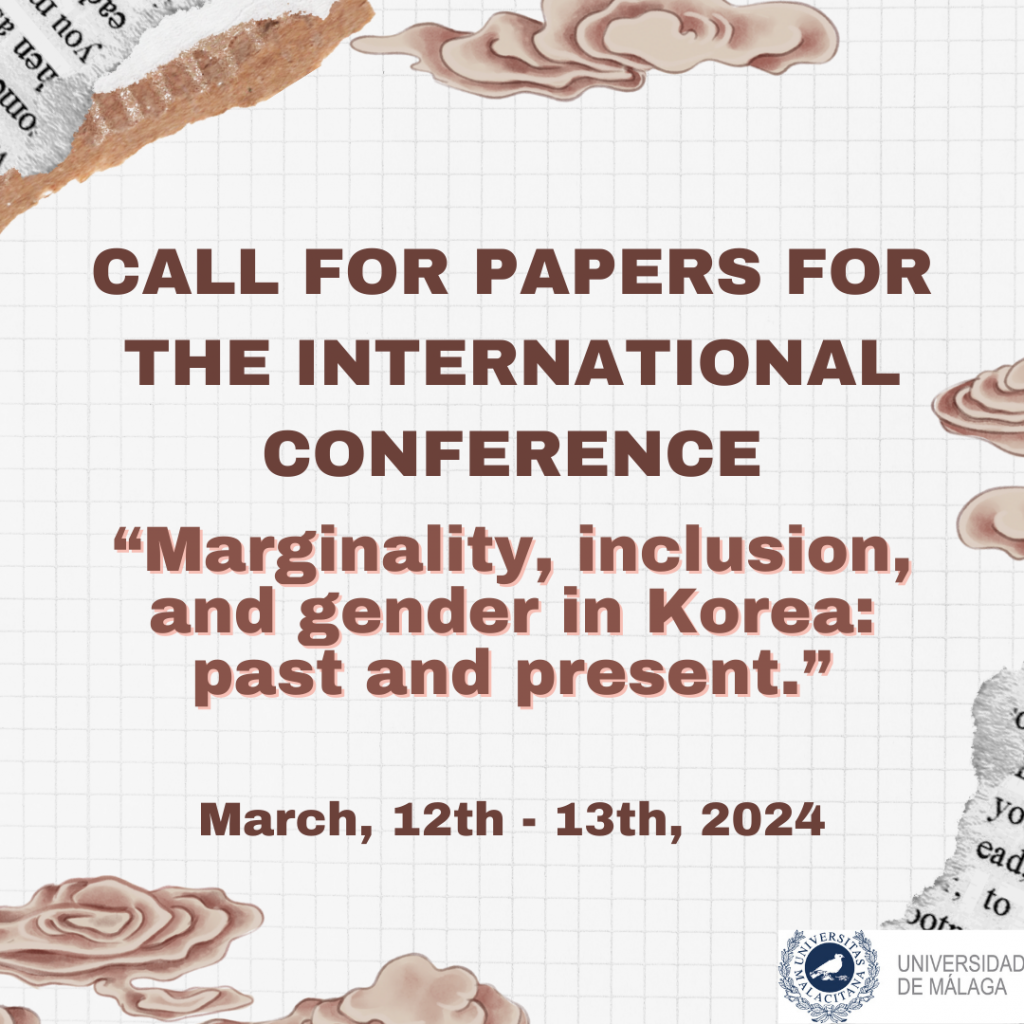
CFP: INTERNATIONAL CONFERENCE "MARGINALITY, INCLUSION, AND GENDER IN KOREA: PAST AND PRESENT"


International Conference

Marginality, inclusion, and gender in Korea: past and present


The East Asian Studies Area of the University of Malaga, Spain is pleased to announce the International Conference “Marginality, inclusion, and gender in Korea: past and present” on March 12th, 13th of 2024.

The Conference is organized as part of the research project Academy of Korean Studies Seed Program for Korean Studies (Advanced Track) “Path to Equality: Korean Studies Network on inclusiveness” (AKS-2021-INC-2250002) the Spanish National project I+D+I ASIA-SLAVES “The road to freedom in the Joseon period in Korea: Slavery and abolitionism in the context of East Asia” (PID2020-116910GB-I00) and the University of Málaga research project “Life Stories of Korean Gisaeng Slaves” (B1-2022_07).

This conference aims to consider the interrelated processes of discrimination and integration of social groups inside Korean society from a broad methodological and thematic perspective. This Call for papers encourages contributions dealing with the analysis of the cultural and institutional process of social discrimination in Korea, as well as political movements and institutional transformations directed to the integration of social groups previously discriminated against. The following topics are of interest, but are not limited to these: nobi system, discrimination against women, the situation of factory workers, disabled individuals, LGBTIQ+ communities, or migrant minorities. It is also considered of interest Korean social movements that through history have advocated for the rights of these marginalized groups, such as democratic unions in the 1970s and 80s, LGBTQ+ activists, or NGOs supporting disabled people and migrants.

The conference is organized in 4 panels to be composed by a maximum of 4 speakers.
  • Panel 1: Gender, voices of women and gisaeng in Korea
  • Panel 2: Slavery, force labour and human trafficking in Korea
  • Panel 3: Social minorities in Korea
  • Panel 4: Social and political activism in Korea
* Conference languages are English and Korean, and online presentations are permitted.


Proposal submissions

To propose an individual presentation, please send a maximum of 300-word abstract on the topic of your presentation (either in English or Korean). The proposals will be sent at the following account asiaoriental@uma.es. The file and subject of the email should include name as follow: Lastname_IntConferenceMIGKorea (ex: Kang_IntConferenceMIGKOREA). Submissions should be sent before November 15th, 2023

Abstracts should include:
  1. Name, position and affiliation
  2. Title of the paper
  3. Abstract
  4. Keywords
You will be sent a confirmation that your application has been received. If you do not receive a confirmation within 5 days after you sent it, please, send your application over again.

In the case of being selected, it will be expected to submit a full-paper before the conference with the possibility, after submission, of being selected for the publication in the format of an edited volume.

*Depending on the final budget the organization might support partially attendance expenses.


Important information:

Organizer contact details: asiaoriental@uma.es

Dates of the conference: March, 12th-13th, 2024.

Conference venue: University of Malaga, Spain.

Application deadline: November, 15th, 2023.

Submitting full paper: will be noticed after accepting proposals.

CFP: 2023 IKSU-K-UNIFICATION FRIENDS INTERNATIONAL CONFERENCE FOR YOUNG SCHOLARS


Tracing the Steps Toward Korean Unification: Learning from the Past to Prepare for the Future,

2023 IKSU International Young Scholars Conference


The International Institute of Korean Studies (IKSU) at the University of Central Lancashire (UCLan) is pleased to announce the 2-day 2023 IKSU International Young Scholars Conference. The conference aims to give junior scholars in the field of Korean studies and unification studies an opportunity to present their research, strengthen ties with other young scholars, and raise awareness of the unification issue in the Korean peninsula among the youth.

The conference aims to facilitate informed, interdisciplinary discussions on the potential benefits and challenges of Korean Unification by looking into how we can learn from the past toward preparing for the future. We are inviting young scholars aged between 19-34 including early career researchers who obtained their PhD degree in the recent five years and PhD candidates who are near to completion of their PhD programmes doing their research in relation to the theme of the forum.
  • Submission Details: Abstract Submission Deadline (max. 500 words): 15 October 2023
  • Acceptance Notice: 31 October 2023
  • Full Paper Submission Deadline (min. 4,000 words including references): 20 November 2023
  • Conference Dates: 1-2 December 2023.
Presenters will receive an honorarium of KRW 400,000 upon successful submission of a policy brief following the conference. Participants are expected to summarize their research into a 1-2 page-long policy brief that will be published through the Northern England Policy Centre for the Asia Pacific (NEPCAP) website.

CFP: 2023 KOREAN LITERATURE REVIEW CONTEST, LITERATURE TRANSLATION INSTITUTE OF KOREA


2023 Korean Literature Review Contest, Literature Translation Institute of Korea


Pautas del Concurso de Reseña de Literatura Coreana 2023 

CÓMO PARTICIPAR EN EL CONCURSO 

Pasos a seguir
  • PASO 1 Elija uno de los cinco libros designados.
  • PASO 2-1. [Informe del libro] envíe su obra participante en línea directamente
  • PASO 2-2. [Dibujo/Video] Suba en su canal de red social su obra participante
  • PASO 3 Envíe su obra participante en línea. 
1. Categoría: Informe del libro
  • Cómo participar: Suba su trabajo a la web
  • Plataforma de presentación: Haga clic en el siguiente enlace para descargar el formulario LINK 
2. Categoría: Video
  • Cómo participar: Suba su obra participante en su red social, luego envíe el URL en el que subió su obra participante junto con su obra participante en la página web del concurso.
  • Plataforma de presentación: Instagram, Facebook, Youtube, TicTok
3. Categoría: Video
  • Cómo participar: Suba su obra participante en su red social, luego envíe el URL en el que subió su obra participante junto con su obra participante en la página web del concurso.
  • Plataforma de presentación: Instagram, Facebook, Youtube, TicTok
※ ¡Todos los lectores apasionados por o interesados en la literatura coreana pueden participar en el concurso!

Exclusiones: 1) Ciudadanos coreanos, 2) Niños menores de 14 años.

Idiomas disponibles

Inglés / Español / Chino / Indonesio / Árabe


CALENDARIO DEL CONCURSO
  • Período de solicitud: 10 de julio (lunes) ~ 30 de septiembre (sábado) 11:59 p.m. de Corea Período de revisión : 2 de octubre (lunes) ~ 20 de octubre (viernes)
  • Anuncio de los seleccionados: 24 de octubre (martes)
  • Viaje a Corea : Principios de noviembre (8 noches y 9 días)
※ Consulte las preguntas frecuentes para obtener más detalles sobre la invitación de viaje a Corea. 


TEMAS POR CATEGORÍA

¿Cuál fue la situación que más te gustó del libro?

1. Informe del libro 
  • Texto (2000 palabras)
    • Elige la frase o escena que más te gustó y expresa libremente los motivos y tus sentimientos. 
2. Video 
  • Vídeo de 3 minutos o Cortometraje de 60 segundos
    • Opción #1 Actúa o lee tu escena favorita.
    • Opción #2 Crea tu propio final del libro.
    • Opción #3 Expresa libremente tu parte favorita del libro.
3. Dibujo
  • Cartel
    • Opción #1 Crea tu propia portada del libro
    • Opción #2 Dibuja al personaje del libro utilizando tu imaginación
    • Opción #3 Crea un cartel promocional del libro
  • Webtoon
    • Opción #1 Crea tu propio final del libro 
    • Opción #2 Crea tu versión de la historia 
    • (ej.) ¿Qué habría pasado si el personaje principal hubiese actuado de otra manera? 
  • Caligrafía
    • Elije la frase del libro que más te ha impresionado y visualízala.

Guía para la presentación de participación 

[Informe del libro] Categoría
  • Formato: Word
  • Tamaño de fuente: 11puntos
  • Espacio entre línea: 160%
  • Texto: Hasta 2000 palabras
  • Nombre del archivo: ‘Nombre del libro_Nombre completo_cumpleaño’ (ej.) Ballena_Juan_mmdd
[Video] Category 

VIDEO
  • Relación de aspecto: 1920 x 1080px (16:9)
  • Resolución: Full HD
  • Duración del video: Hasta 3 minutos (Horizontal)
  • Formato del archivo: MP4 · Capacidad limitada: por debajo de 300MB
  • Plataforma de presentación: Instagram, Facebook, Youtube, TicTok
  • Debe incluir los siguientes hashtags en las redes sociales al subir su participación. #2023KLRC #LTIKOREA #ConcursoReseñaLiteraturaCoreana #LiteraturaCoreana 
CORTOMETRAJE
  • Relación de aspecto: 1080 x 1920px (9:16)
  • Resolución: Full HD
  • Duración del video: Hasta 60 segundos (Vertical)
  • Formato del archivo: MP4
  • Capacidad limitada: por debajo de 300MB
  • Plataforma de presentación: Instagram, Facebook, Youtube, TicTok 
  • Debe incluir los siguientes hashtags en las redes sociales al subir su participación. #2023KLRC #LTIKOREA #ConcursoReseñaLiteraturaCoreana #LiteraturaCoreana 
[Dibujo] Categoría

Cartel
  • Envío estándar: Horizontal / Vertical (Uno)
    • Horizontal: 1080 x 1080 píxeles
    • Vertical: 1080 x 1350 píxeles
  • Resolución: Más de 300dpi
  • Formato del archivo: JPG, PNG
  • Plataforma de presentación: Instagram, Facebook
    • ※ Se acepta tanto dibujo en línea y dibujo manual.
Debe incluir los siguientes hashtags en las redes sociales al subir su participación. #2023KLRC #LTIKOREA #ConcursoReseñaLiteraturaCoreana #LiteraturaCoreana 

WEBTOON
  • Envío estándar: 1080 x 1080 píxeles (1:1)
  • Límite de lienzo: 8 to 10 lienzos, incluyendo el título
  • Resolución: más de 300dpi
  • Formato de archivo: JPG, PNG
  • Nombre de archivo: Número por imagen (ej. 01, 02, 03, ‧‧‧ ,10)
  • Plataforma de presentación: Instagram, Facebook ※ Se acepta tanto dibujo en línea y dibujo manual. 
Debe incluir los siguientes hashtags en las redes sociales al subir su participación. #2023KLRC #LTIKOREA #ConcursoReseñaLiteraturaCoreana #LiteraturaCoreana 

CALIGRAFÍA
  • Envío estándar: 1080 x 1080 píxeles (Uno)
  • Resolución: más de 300dpi
  • Formato de archivo: JPG, PNG
  • Plataforma de presentación: Instagram, Facebook 
    • ※ Se acepta tanto dibujo en línea y dibujo manual. 
Debe incluir los siguientes hashtags en las redes sociales al subir su participación. #2023KLRC #LTIKOREA #ConcursoReseñaLiteraturaCoreana #LiteraturaCoreana 

PREMIOS DEL CONCURSO

¡Se seleccionará un total de 123 ganadores! 

PREMIO 1ro
  • No. de Ganador(es): 3 (1 en cada categoría)
  • Contenido: Viaje a Corea
PREMIO 2do
  • No. de Ganador(es): 15 (1 en cada categoría e idioma)
  • Contenido: Tableta
PREMIO 3ro
  • No. de Ganador(es): 30 (2 en cada categoría e idioma)
  • Contenido: Lector de libros electrónicos
PREMIO 4to
  • No. de Ganador(es): 75 (5 en cada categoría e idioma)
  • Contenido: Tarjeta de regalo de Amazon ($50)
Beneficio de Misión Especial para los 123 Ganadores

Los ganadores serán calificados automáticamente como Embajadores Globales del Concurso de Revisión de la Literatura Coreana. Si completa bien la misión asignada, los ganadores recibirán como recompensa el K-BOX (K-Comida, K-Merienda, etc).


Derechos de autor y otros puntos importantes

1. El trabajo enviado finalmente, no se puede modificar. Revise minuciosamente antes de enviar la presentación final. 

※ Después de la fecha límite de presentación es imposible cambiar el contenido, tampoco se puede enviar. 

2. No hay límite en el número de presentación, también es posible la repetición de la presentación. Sin embargo, es imposible la participación con el mismo libro en la misma categoría. Entre los trabajos enviados repetidamente, solo una obra puede ser premiada. 

(Es posible)
  • 『Sobre mi hija』 Presentación del informe del libro, cortometraje, cartel
  • Presentación del Informe del libro 『Sobre mi hija』 y 『Si no podemos viajar a la velocidad de la luz』 
(Es imposible) 
  • Presentación de tres Informe del libro de solo la obra 『Sobre mi hija』 

3. Los derechos de autor y de propiedad pertenecen al creador del trabajo premiado, pero la obra puede ser utilizada y distribuida sin fines de lucro de acuerdo a las necesidades del Instituto de Traducción de la Literatura Coreana (organizador de la competencia) 

※ Los trabajos presentados que no han sido selectos, serán desechos en un plazo de 3 meses a partir de la fecha de finalización 

4. En los siguientes casos, el trabajo presentado podrá ser excluido de la evaluación o descalificado del premio. 
  1. En caso de infracción o posible infracción de los derechos de otros, como derechos de autor (sea individual o corporativo), de la marca registrada, de la privacidad, de la publicación u otros derechos de la propiedad privada. 
  2. En caso de que se confirme el plagio através de la comparación/verificación con el texto original 
  3. En caso de difamar la reputación de otros o incluir información ilícita 
  4. En caso de introducir información errónea del participante 
  5. En caso de desorientarse del tema de la competencia o no cumplir con los estándares de la presentación 
  6. En caso de que se confirme que no es una creación propia, y haya recibido la ayuda de otra persona o máquina(inteligencia artificial) 
  7. En caso de que se confirme que se haya publicado, divulgado o distribuido previamente sin importar la forma, o que haya ganado algún premio 
※ Los puntos que no han sido mencionados en este aviso, están sujetos a seguir los reglamentos pertinentes y las normas de los ministerios correspondientes 
※ Prepare con anticipación materiales que demuestren el proceso de realización del trabajo premiado ya que se prevee solicitarlos. 

5. En caso de infracción de los derechos de autor, todas las disputas legales relacionadas son responsabilidad exclusiva del participante, ni el organizador ni la agencia se hacen responsables por ello. 

6 Los premios otogados a los ganadores pueden cambiarse por otros, los gastos y los posibles problemas que incurran al recibir el premio son responsabilidad del ganador.

BECA 2024 KF FELLOWSHIP FOR KOREAN LANGUAGE TRAINING


2024 Beca Korea Foundation

para capacitación en idioma coreano (KLT)


Desde 1993, la Korea Foundation ofrece un programa anual de becas para la enseñanza del idioma coreano (KLT) para la promoción y difusión general del idioma coreano, que es la base que promueve los estudios coreanos y otras actividades relacionadas con Corea fuera del país. De acuerdo con las pautas enumeradas a continuación, la Fundación actualmente acepta solicitudes para su programa KLT 2024.


Resumen del programa

La beca KF para la capacitación en idioma coreano (KLT) brinda la oportunidad para estudiantes y doctorados e investigadores de estudios coreanos de aprender coreano en un programa intensivo de inmersión en una universidad de Corea durante seis meses.


Número de becas disponibles

Aproximadamente 30 cada año.

 
Requisitos

Estudiantes y doctorados que se especialicen en estudios coreanos (humanidades, ciencias sociales y artes y cultura) y que estén actualmente involucrados en investigaciones relacionadas con Corea, pueden postularse para el programa KLT. Todos los que realicen la solicitud deberán ser capaces de entender y hablar al menos coreano básico.

1. Estudiantes de master/doctorado

Estudiantes de posgrado y doctorado que busquen una especialización o especialización en un campo relacionado con Corea con una propuesta de tesis/disertación detallada sobre un tema relacionado con Corea.

2. Estudiantes de grado
  • ① Estudiantes de grado cuya especialización o especialidad sean los Estudios Coreanos (o Lengua y Literatura Coreanas) y que estén al menos en el tercer año de sus respectivos cursos.
  • ② Estudiantes de grado que estén al menos en el tercer año de sus respectivos cursos y hayan tomado más de ocho estudios coreanos o clases de idioma coreano en una universidad que no ofrezca ningún estudio coreano o títulos de idioma coreano.
A tener en cuenta:
  • Los solicitantes deben adjuntar evidencia de que la universidad no ofrece estudios coreanos o títulos de idioma coreano en (3) Transcripción de calificaciones del trabajo del curso (por ejemplo, una captura de pantalla de los cursos de grado ofrecidos en los sitios web de las respectivas escuelas).
  • Los solicitantes deben presentar transcripciones detalladas para todas las clases.
  • Si las escuelas de los solicitantes ofrecen títulos relacionados con Corea, no son elegibles para postularse incluso si anteriormente han tomado más de ocho cursos relacionados con Corea.
Tenga en cuenta que las personas que correspondan a cualquiera de los siguientes perfiles NO serán consideradas para la beca:
  • Ciudadanos coreanos
  • Personas que ya estudian o realizan investigaciones en Corea
  • Individuos que planean inscribirse en un programa de grado en una institución de educación superior en Corea
Tenga en cuenta que durante el período de la beca, uno no puede registrarse para un programa de grado en una universidad coreana.
  • Individuos que ya han recibido la beca KF para capacitación en idioma coreano en los últimos 2 años (2022–2023).

Términos y detalles del apoyo del programa

1. Matrícula y otras tasas para la institución educativa

2. Estipendio para cubrir gastos de manutención parciales (pagado mensualmente)
  • ① Estudiantes universitarios, B.A. o Titulares de maestría: KRW 1,200,000
  • ② Doctorado candidatos: KRW 1.400.000
3. Subsidio de viaje (beneficio único)
  • ① Estudiantes universitarios, B.A. o Titulares de maestría: KRW 300,000
  • ② Doctorado candidatos: KRW 500.000
4. Seguro de salud (seguro médico y de accidentes proporcionado por una compañía de seguros coreana)

Tenga en cuenta que no se proporcionará la tarifa aérea.


Calendario del programa

1. Período de solicitud: 1 de julio de 2023 al 31 de agosto de 2023 / 6:00 p. m. (hora estándar de Corea)

2. Entrevista de verificación del dominio del idioma coreano: noviembre de 2023

Tenga en cuenta:
  • Quienes hayan superado la etapa de revisión de documentos recibirán orientación específica vía correo electrónico.
  • El propósito de esta entrevista no es evaluar las habilidades del idioma coreano de los solicitantes. Es para confirmar si los certificados de dominio del idioma coreano presentados (por ejemplo, TOPIK, KLPT, etc.) son consistentes con el dominio real del coreano de los solicitantes.
3. Notificación de Resultados: Diciembre 2023

Tenga en cuenta que la fecha de notificación está sujeta a cambios sin previo aviso. Los solicitantes serán notificados individualmente por correo electrónico.

4. Período de beca: 6 meses
  • Los postulantes podrán iniciar su período de beca en marzo o septiembre de 2024.

Documentos requeridos

1. Formulario de solicitud en línea
  • ① Datos personales del solicitante
  • ② Propuesta (Dentro de 400 palabras en inglés o 400 sílabas en coreano, explique sus razones y objetivo para emprender la capacitación en idioma coreano, la necesidad de competencia en el idioma coreano en sus estudios o trabajo actual y sus planes futuros).
2. Copia del Grado Académico Máximo del Solicitante

3. Evidencia de dominio del idioma coreano

Presentar al menos un documento que corresponda a los siguientes certificados:
  • ① Certificado que prueba el dominio del idioma coreano, por ejemplo, TOPIK o Prueba de dominio del idioma coreano (KLPT)
Tenga en cuenta: Se dará preferencia a los solicitantes con dominio TOPIK Nivel 3 o 4.
  • ② Transcripciones de programas de idiomas universitarios u otros documentos adecuados
  • ③ Premio oficial que prueba el dominio del coreano del solicitante, por ejemplo, premio de un concurso de oratoria coreano organizado por una embajada coreana
4. Dos cartas de referencia

Tenga en cuenta: cada carta debe provenir de un árbitro diferente.
  • ① Jefe de institución afiliada, por ejemplo, jefe de departamento, supervisor de tesis, etc.
  • ② Instructores de idioma coreano (deben ser profesores o disertantes autorizados que se especialicen en coreano y sean capaces de evaluar el nivel de dominio del coreano del solicitante).
5. Certificado de inscripción (Debe haber sido emitido después del 1 de mayo de 2023)

6. Transcripciones

Tenga en cuenta que los estudiantes que aún no se han graduado también deben enviar las calificaciones del semestre de primavera de 2023.
  • ① Estudiantes de pregrado
Transcripción de calificaciones recibidas por todo el trabajo académico de pregrado
  • ② MA/Ph.D. candidatos
Transcripción de calificaciones recibidas por todo el trabajo académico de pregrado y posgrado


Recordatorios importantes para la presentación
  • El formulario de solicitud y todos los documentos deben presentarse en inglés o coreano. Si los documentos se envían en otros idiomas, envíe tanto el archivo original como una traducción certificada ante notario.
  • Solo se puede cargar un archivo PDF por categoría de archivo adjunto.
  • Solo se aceptarán archivos escaneados (en formato PDF), así que convierta cualquier archivo jpg, png u otro archivo de imagen a archivos PDF.
Notas
  • A quienes se les otorgue la beca se les puede solicitar que presenten documentos adicionales a la KF.
  • Después de que los solicitantes envíen su solicitud en línea, el sistema de solicitud en línea enviará automáticamente correos electrónicos a los árbitros cuyas direcciones de correo electrónico hayan proporcionado los solicitantes. Por lo tanto, los solicitantes deben informar a sus árbitros sobre su solicitud de una carta de recomendación antes de presentar la solicitud. (Ambas recomendaciones deben recibirse durante el período de presentación de la solicitud para que la solicitud sea procesada. No se harán excepciones).
Cómo solicitarla

Las solicitudes deben enviarse a través del portal de solicitudes en línea de KF (http://apply.kf.or.kr).

Haga clic en el botón "Aplicar" en la parte inferior de este anuncio del programa y complete el formulario de solicitud en línea.
  • Antes de presentar la solicitud, primero debe registrarse como miembro del Portal de solicitud en línea de KF (http://apply.kf.or.kr).
  • El botón 'Aplicar' solo se activa durante el período de solicitud del 1 de julio al 31 de agosto de 2023.
  • Las bibliografías o citas en cualquier publicación o disertación incluidas con la solicitud deben seguir los estilos APA o MLA.
  • Haga clic en el botón "Guardar temporalmente" cada vez que realice cambios en la solicitud, especialmente cuando adjunte documentos complementarios.

Responsabilidades

Los beneficiarios de la beca deben progresar al siguiente nivel de idioma más alto para cada período de estudio. Una vez finalizado el período de la beca, los beneficiarios deben presentar un informe final de sus resultados a la Fundación de acuerdo con un formato proporcionado por la KF.


Recordatorios importantes para la beca

1. En 2024, la institución en la que los becarios tomarán cursos es una universidad en Corea seleccionada por la KF. Los beneficiarios no pueden elegir otra institución.

2. Los beneficiarios deben comenzar sus períodos de beca en marzo o septiembre de 2024.

3. Los beneficiarios no podrán diferir la matrícula para el año siguiente.

4. Durante el período de la beca, los beneficiarios de la beca no pueden recibir apoyo de otro programa KF u otra institución.

5. Durante el período de la beca, los beneficiarios no podrán realizar ningún tipo de actividad lucrativa o remunerada.

6. Toda la información personal recopilada como parte de su solicitud se utilizará exclusivamente para el programa, y el envío de la solicitud se considerará como su consentimiento para la recopilación de su información personal.

7. El número de becarios está sujeto a cambios debido a consideraciones presupuestarias.

8. En noviembre de 2023, se enviará un correo electrónico con orientación sobre la entrevista a quienes pasaron la etapa de revisión de documentos. Aquellos que no asistan a la entrevista por motivos personales, incluido el hecho de no revisar sus cuentas de correo electrónico, no serán seleccionados.

9. Consulte las preguntas frecuentes adjuntas si tiene más preguntas.


Contacto
  • Consultas sobre el programa: fellow@kf.or.kr
  • Si tiene preguntas sobre el portal de solicitudes en línea, comuníquese con: tech-support@kf.or.kr
  • Tenga en cuenta que no respondemos preguntas por teléfono. Lea atentamente las instrucciones antes de aplicar.

CFP: KOREA COMPETENCE WEEK 2023 FOR GRADUATE STUDENTS AND PHD CANDIDATES, FREIE UNIVERSITÄT BERLIN


Korea Competence Week 2023 for Graduate Students and PhD Candidates,


The Korea-Europe Center at the Institute of Korean StudiesFreie Universität Berlin, (FU-IKS) is pleased to announce the Workshop Series <Korea Competence Week 2023> for graduate students and PhD candidates intending to enhance the academic and political competence of those involved in Korea-related research and politics.

The workshop series comprises the following four parts: (In each workshop, more experts will join as instructors.)

1. Methodology Workshop
  • Monday, 25th September 2023
Instructors: 
This workshop is designed to invite Ph.D. students and scholars researching themes related to Korea to meta-analysis and self-reflection of their research. Over the course of this workshop, participants will gain greater awareness of implicit presuppositions, guiding perspectives and values, and blind spots of their own research design. This type of training will enable participants to a more conscious and reflective handling of research methods and the theoretical baggage that comes with them. It will also enhance participants intercultural competence in an increasingly globalizing academic context, and especially that of area studies.

Process of Workshop:

(1) Each participant is expected to give a presentation (20 min.) of the methodology based on the methods of his or her current research.

(2) Each presentation will be followed by a round of comments and discussion with the possibility to focus in-depth on key issues in participants research designs.


2. Publication Writing Workshop
  • Tuesday, 26th September 2023
Instructors: 
This workshop focuses on the dos and don’ts of academic research paper writing and publication. Participants will enhance their ability to write academic papers and how to clearly structure them, focusing on key components such as abstract writing and preparing the finished paper for submission to a journal. Participants will also learn about publication processes. With the help of an experienced journal editor, they will learn how to choose the right journal for their paper, navigate peer review, and think strategically about building visibility for their expertise.

Participants will be expected to bring a short sample of their writing, preferably a paper there are currently working on. This workshop will employ a set of peer-tutoring methods among a variety of other techniques.


3. Policy Paper Writing Workshop
  • Wednesday, 27th September 2023 lecture and group work
  • Thursday, 28th September 2023, morning session: group report and evaluation
Instructors: 
This workshop teaches basic techniques and strategies of writing policy papers. Participants have the opportunity to gain knowledge, skills and first-hand insight from people, who are engaged in policy paper writing. The workshop intends to illuminate the context in which policy papers are produced, why they are written, and how they potentially influence decision making processes. The workshop will consist of interactive training sessions, group work and practical exercise.


4. Strategic Dialogue Workshop
  • Thursday, 28th September 2023, afternoon session: lecture
  • Friday, 29th September 2023 including group work and presentation
Instructors: 
Strategic dialogue has been a term used with increasing frequency, both in private and public sectors. It is generally understood as denoting a processual development among groups or teams intending to reach a common understanding concerning goals, concepts or projects in view of a future. Nevertheless, what does "strategic dialogue" exactly mean? How does it differ from a regular "bilateral" or "multilateral" meeting? Is it a formal or informal process? How does it compare and contrast with 1.5 and 2-track discussions? Can academics participate in strategic dialogues, or is it a format limited to practitioners, mostly from the field of politics? Who sets the strategic agenda and how is strategic dialogue organized in practice?

The workshop will examine these and other questions providing a comprehensive overview of the instrument of strategic dialogue. The seminar will host speakers with rich experience and a proven track record in conducting such strategic dialogues with partners in Asia and, in particular, in both Koreas. The guest speakers will share their expertise and provide hands-on experiences. This workshop will also include a model-strategic dialogue in which participants will have the opportunity to prepare and simulate a strategic dialogue under the guidance of experienced practitioners in the field.


Eligibility

Applicants must be either enrolled in a Korean Studies graduate program or undertaking research on a Korea-related theme at a university in Europe.


Application period:

Until August 3rd 2023

The Korea-Europe Center will provide the selected participants with
  • roundtrip train ticket (2nd class) or airfare (economy class) within Europe,
  • board and lodging for the duration of the workshop

Application:

Submit the following documents in one PDF file with the applicants family name as the file name to Dr CHOE Hyondok (hyondok.choe[at]fu-berlin.de)
  • Letter of Motivation
  • Curriculum Vitae
  • List of publications (if applicable)
  • Copy of certificate of enrollment at a European university

Contact:

Dr CHOE Hyondok : hyondok.choe[at]fu-berlin.de


More Information:
  • Date: 25.- 29. September 2023 (Mon.-Fri.)
  • Application deadline: August 3, 2023

CFP: "RELIGIÓN, DISCRIMINACIÓN, INCLUSIÓN Y LIBERACIÓN EN COREA" REVISTA RAPHISA

Religión, discriminación, inclusión y liberación en Corea”,

RAPHISA: Revista de antropología y filosofía de lo sagrado


RHAPISA: Revista de antropología y filosofía de lo sagrado anuncia nueva convocatoria de artículos para el próximo volumen 7, número 2 (diciembre de 2023), que estará dedicado a LA RELIGIÓN, FILOSOFÍA Y PENSAMIENTO EN COREA. La edición estará a cargo del profesor Antonio Doménech (Universidad de Málaga) y la profesora Eun Kyung Kang (Universidad de Málaga).

Este número de la revista tiene como objetivo explorar desde un enfoque multidisciplinario la relación entre las religiones, el pensamiento religioso y filosófico, y los procesos de discriminación, inclusión y liberación que se han dado en la península coreana a lo largo de su historia. Se trata de analizar e investigar desde diferentes perspectivas y disciplinas las condiciones sociales, los discursos, las estructuras, los movimientos sociales y religiosos, las ideologías, las ideas religiosas y filosóficas, las prácticas religiosas y los acontecimientos históricos que han propiciado el desarrollo de mecanismos de marginación individual y colectivas, así como la aparición de movimientos encaminados a la liberación e inclusión social.

Por ello, se inicia ahora un llamamiento para contribuciones, que deberán ajustarse de forma necesaria a lo establecido en la web de la revista.

La recepción de artículos para este número estará abierta hasta el día 1 de septiembre de 2023, admitiéndose textos en español, portugués, francés, italiano e inglés.

CFP: THE UNDERSTANDING KOREA CONTEST 2023


“The Understanding Korea”

Contest 2023


1. Essay topics
  • International Images of Korea
    • Images of Korea as presented in international instruction materials (international textbooks, internet sites, etc.)
    • Proposals on how to improve the image of Korea
  • Notable Applications of using Understanding Korea Materials

o Notable Applications of using Understanding Korea materials and proposals for new materials.

* Understanding Korea materials published by AKS are available here.


2. Eligibility: Foreigners, Koreans living abroad


3. Submission: Submit via the official website of the Academy of Korean Studies
  • Language: Korean or English
  • Essay Length: Approximately 3 pages in A4 format
* Download the application form from “Notice” on the Academy of Korean Studies website or the Center of International Affairs website, complete the provided application form and submit accordingly. Incomplete or incorrect submissions may be disqualified.

* Applications can be submitted using either Topic 1, Topic 2, or both.


4. Prizes
  • Gran Prize:
    • Number of Awardees: 2
    • Award:
      • § Award certificate presented by the Ministers of MOFA and MOE
      • § Merchandise valued at 600,000 KRW
  • Excellence Prize:
    • Number of Awardees: 4
    • Award:
      • § Award certificate presented by the President of AKS
      • § Merchandise valued at 400,000 KRW
  • Encouragement Prize:
    • Number of Awardees: 6
    • Award:
      • § Merchandise valued at 200,000 KRW
* The awardee is responsible for all taxes and fees associated with prize receipt and/or use.


5. Application Period: June 1 - July 31, 2023, 18:00

* Applications submitted after the deadline (Korea Standard Time) will not be considered for evaluation.


6. Announcement of winners: September 25, 2023 (scheduled)

* The result of the contest will be posted on the Center's website and all winners will be notified individually.


Email: highspirit@aks.ac.kr

* For any inquiries regarding the contest, please direct your questions exclusively via email.


SEMANA CULTURAL COREANA: CHARLAS SOBRE COREA


Semana Cultural Coreana:

Charlas sobre Corea


Exposición de trajes HANBOK para niños

Indumentaria tradicional infantil de Corea

Fechas: 23 – 27 del mayo, martes - sábado, 10:00 – 15:00 h

Lugar: Real Academia de Bellas Artes San Fernando

Asistencia: Entrada libre y gratuita


Semana del Cine Coreano

Lugar: Cines Verdi Madrid (C. de Bravo Murillo, 28)

Programa:
  • La novelista y su película (Hong Sang-soo, 2022): 24 de mayo, miércoles, 20:15 h
  • Minari. Historia de mi familia (Lee Isaac Chung, 2020): 25 de mayo, jueves, 20:15 h
  • Broker (Hirokazu Koreeda, 2022): 26 de mayo, viernes, 11:30 
  • Hunt. Caza al espía (Lee Jung-jae, 2022): 27 de mayo, sábado, 11:30 h
Asistencia: Entrada libre y gratuita hasta completar aforo


Charlas sobre Corea

Ponencias para conocer más sobre Corea con expertos
  • Primera Jornada: 23 de mayo, martes, 12:00 h
    • Tema y ponentes:
  • Segunda Jornada: 25 de mayo, jueves, 12:00 h
    • Tema y ponentes:
      • “La península coreana: historia de dos realidades tan lejanas como cercanas”, Rafael Bueno, Director de Casa Asia
Asistencia: Entrada libre y gratuita hasta completar aforo


La Voz de Corea

Recital de solista coreano Il Hong con repertorio de música clásica coreana y óperas famosas
  • Primer concierto: 25 de mayo, jueves, 12:00 h
    • Programa:
      • “Madamina, il catalogo è questo”, <Don Giovanni>, Wolfgang Amadeus Mozart
      • “Votre toast, je peux vous le rendre", <Carmen>, Georges Bizet
  • Segundo concierto: 26 de mayo, viernes, 12:00 h
    • Programa:
      • “Nadie podría saber”, Wonsik Lim
      • “Añorando el pasado", Jin Choi
      • “Come dal ciel precipita", <Macbeth>, Giuseppe Verdi
      • “Despierta negro, que viene el blanco", <La tabernera del puerto>, Pablo Sorozábal
      • “Madamina, il catalogo è questo”, <Don Giovanni>, Wolfgang Amadeus Mozart
      • “La montaña", Shin Dongsu
      • “Balada sobre la montaña Shingo”
      • “Miei rampolli femminini”, <La Cenerentola>, Gioachino Rossini
      • “Udite, udite o rustici", <L’elisir d’amore>, Gaetano Donizetti
Asistencia: Entrada libre y gratuita hasta completar aforo


Concierto y K-Fashion

Desfile de moda HANBOK con modelos españoles y Concierto de Grupo Vocal MILLENNIUM con vocalistas españoles cantando en coreano.

Fecha: 27 de mayo, sábado, 19:30 h

Lugar: Teatro Monumental

Asistencia: Reserva previa de entradas gratuitas. S.R.C antes del 17 de mayo.

CFP: “NEOLIBERAL ASIA AND ITS PRECARIOUS OTHERS”, 2023 SITUATIONS INTERNATIONAL CONFERENCE


“Neoliberal Asia and Its Precarious Others”,

2023 Situations International Conference

October 20-21, Grand Hyatt Jeju, South Korea


The modern history of Asia has been characterized by rapid and even spectacular growth, as societies that were poor and agrarian became prosperous and advanced through the process of state-led development. But the much-vaunted successes of the developmental state have often served to conceal intractable problems and troubling realities. The neoliberal economic model has exacerbated inequalities across the globe, and Asia has not been spared the pernicious dynamic whereby a few have achieved tremendous wealth while many more have fallen out of the middle class and are confronted with an increasingly gloomy and uncertain future. Precarity has driven these issues to the fore, as the loss of faith in the future has come to unsettle and weaken social cohesion in Asia just as it has dissolved it across the West.

This conference examines the experience of precarity in Asia, past and present. Whether it relates to contract laborers working without benefits, migrants seeking low-wage jobs, the physically handicapped cut off from steady employment, the neuro-diverse negotiating the rules of corporate culture, or gays and lesbians carving out a niche in a traditional society, Situations welcomes papers from a wide variety of perspectives taking on these and other issues related to the worsening instability of social structures and the spread of uncertainty in traditionally communitarian Asian societies. How have members of marginal or disenfranchised groups responded to the predicaments of precarity, and how are views of these groups changing among the general public? What kind of politics are emerging in response to mass disillusionment regarding a better future, and what kind of influence are disenfranchised groups beginning to exert against the forces arrayed against them? Could precarity also provide opportunities for marginalized groups that did not exist in the past?


Invited Speakers:
    • “Democracy or Totalitarianism? Terms of the New Cold War”
    • “Thresholds of Precarity”
    • “The Viscous Return of the Rheol”

Possible topics might include:
  • labor and precarity
  • disability rights
  • migrant workers in Asia
  • precarity and the shaping of biopolitics
  • the crisis of the low birth-rate
  • the emergence of neuro-diversity (such as Extraordinary Attorney Woo)
  • the transformation of family life
  • gender identity in uncertain times
  • cults as a phenomenon of precarity
  • Squid Game and other metaphors of precarity
  • environmental politics and the loss of the future
  • precarity and the experience of deep time
  • the impact of the Old and the New Cold War
  • lives under authoritarian regimes
Early inquiries with 200-word abstracts are appreciated. By 20 August 2023, we would invite you to submit your 4,000-word Chicago-format conference presentation with its abstract and keywords (the acceptance of the presentation will be decided based on the 4,000-paper). Each invited participant will then be expected to turn his or her conference presentation into a finished 6,000-word paper for possible inclusion in a future issue of the SCOPUS-indexed journal, Situations: Cultural Studies in the Asian Context. All inquiries and submissions should be sent to both situations@yonsei.ac.kr and skrhee@yonsei.ac.kr.

Submissions should follow the Chicago Manual of Style (16th ed.), using only endnotes.


Notes:

We will pay the hotel accommodation for those participants whose final papers we accept. The presenters will share twin bedrooms.

Contact Info:

situations@yonsei.ac.kr; skrhee@yonsei.ac.kr.

Contact Email:

situations@yonsei.ac.kr

CFP: "NATURAL DISASTER AND SOCIAL (IN)JUSTICE", TRANSNATIONAL ASIA JOURNAL


“Natural Disaster and Social (In)Justice”, 


One hundred years since the Great Kanto Earthquake in Japan.

September 1, 2023 will mark the one hundredth year of the Great Kanto Earthquake in Japan that killed hundreds of thousands of people and damaged vast areas in the vicinity of Tokyo and Yokohama. 

By the end of that day, 1923, rumors began circulating blaming Koreans for the fire, looting, and rape. As a result, thousands of Koreans in Japan in these areas were hunted down and lynched by Japanese civilian vigilantes. These Koreans were colonial immigrants who moved to Japan seeking work opportunities following Japan’s colonial annexation of Korea in 1910. 

To this day, we often witness disasters that reveal various forms of xenophobia and racial and ethnic discrimination. For instance, following the recent catastrophic earthquake in Turkey, many Syrian refugees who had settled in the disaster-affected areas were harassed and discriminated against when trying to seek assistance. 

In this year of the one hundredth anniversary of the Great Kanto Earthquake, the Transnational Asia editorial committee calls for papers that address responses to natural disasters such as earthquakes, storms, floods and famines––responses that are historically conditioned, prioritizing some people and leaving others behind––or worse, eliminating some populations altogether. We interpret “natural disaster” broadly, since more often than not “natural” disasters are not completely natural. Send your 500-word abstract to transnational.asia@rice.edu.

CFP: "FRAMING SUSTAINABLE SECURITY ON THE KOREAN PENINSULA", NUMBER 5, KOREA EUROPE REVIEW


“Framing Sustainable Security on the Korean Peninsula”,

Number 5, Korea Europe Review


Guest editor: Francesca Frassineti 

The Korea Europe Review (KER) is an interdisciplinary platinum open access, peer-reviewed journal specialising in Korean Studies and encompassing the social sciences in a broad sense. While the primary focus is on the Korean peninsula, the journal’s perspective aims to transcend the traditional boundaries of Area Studies in its mission to integrate scholarship on Korea in a multidimensional context of regional as well as global social, cultural, and political discourse.


The Korea Europe Review is now inviting submission proposals for Issue 5 forthcoming in November 2023.

July 2023 will mark the seventieth anniversary of the Korean War Armistice Agreement. Still, the Korean peninsula continues to be one of the major security hotspots in East Asia, stuck in repeating action-reaction cycles. In addition to a high concentration of military assets for deterrence purposes within a geographically limited space and the ensuing increased escalation risk, broader competition between great powers has continually constrained and overridden local dynamics, which further complicates the already precarious status quo on the peninsula.

Beyond concerns over power imbalances across the conventional and nuclear domain, Koreans have also been faced with new, non-traditional security challenges. The regime of Kim Jong Un appears unwilling to ease isolation any time soon regardless of the international community warning of a looming humanitarian crisis in North Korea, further exacerbated by more frequent extreme weather events. Rather, Pyongyang has sought to take advantage of Washington’s tense relationship with Russia and China in the context of the war in Ukraine to progress towards a number of military development goals with relative impunity.

Against the backdrop of COVID-19 and fierce competition between the US and China, Seoul – on the other hand – has been progressively drawn into the middle of new fault lines, particularly with regards to the technological field. In the midst of global protectionist trends and efforts to securitise supply chains, the South Korean government has increasingly turned to new and emerging technologies to address the far-reaching implications of lower birth rates and a shrinking workforce. Although intensive digitalisation could push sustainable economic growth, it has already made South Korea a more vulnerable target of an ever-expanding and increasingly sophisticated spectrum of cyber operations that have been largely ascribed to North Korean state-sponsored actors. Besides using the cyber domain to carry out interference and espionage activities, the impacts of longstanding sanctions and COVID-19 induced blockades have led to a surge in Pyongyang’s alleged cyber activism aimed at generating illicit income. Faced with the specter of evolving and increasing cyberattacks, South Korea is forced to strengthen the resilience of critical infrastructure and take cooperation with the United States, European Union and NATO to the next level.

The issue titled “Framing Sustainable Security on the Korean Peninsula” seeks to approach the evolving security environment on and around the Korean peninsula from a holistic perspective, which encompasses politico-military, economic, environmental, and human factors. Besides the regional level, the aim is to shed light also on the challenges pertaining to the resiliency of local communities. Therefore, we are interested in original and unpublished studies that critically engage with the changes and ideas of security from traditional to non-traditional challenges in all fields related to Korea.

Potential topics may include, but are not limited to:

a) Human security (i.e. economic, food, health, environmental, personal, community, and political security)

b) Demographics with main focus on citizenship

c) The relationship between new media and subjective well-being and emotions (including cyber bullying, fake news, internet activism)

d) Economic security, economic coercion, technology, and innovation

e) South Korea’s contribution to regional and global security and cooperation with like-minded partners such as European and NATO countries (including overseas development assistance, health diplomacy, maritime security, territorial disputes)

f) Crisis management and contingency planning on the Korean peninsula (including alliance politics, defense industry, conventional and non-conventional military capabilities, strategic doctrine)


Please be sure to submit full-length articles no later than April 30, 2023. You are also welcome to discuss your ideas with our editors or equally send in an abstract prior to this date.

If you have any queries concerning your proposal as regards focus or thematic scope, please contact the issue’s guest editor Francesca Frassineti (University of Bologna and Ca’ Foscari University Venice) at francescafrassineti7@gmail.com. For all other inquiries as regards the publication process, author and stylistic guidelines, please contact editors@korea-europe-review.org

A note on article processing charges (APCs): At no stage of the publication process will The KER charge author fees for publication. All publication services rendered, e.g. peer review, editing, formatting etc., are completely free to our authors.

Please also note that in addition to calls with particular thematic foci, the Korea Europe Review also welcomes submissions on a continual year-round basis.


More Information:

Korea Europe Review (KER) ǀ ISSN: 2750-4832


Contact: editors@korea-europe-review.org