Mostrando entradas con la etiqueta conferencia. Mostrar todas las entradas

CONFERENCIA ESPECIAL DEL EMBAJADOR DE COREA EN ESPAÑA, LIM SOOSUK: «SITUACIÓN ACTUAL Y PERSPECTIVAS DE LAS RELACIONES ENTRE ESPAÑA Y COREA»

Con motivo del 75º aniversario del establecimiento de relaciones diplomáticas entre la República de Corea y el Reino de España (1950–2025), la Embajada de la República de Corea en España y el Área de Estudios de Asia Oriental de la Facultad de Filología de la Universidad Complutense de Madrid organizaron conjuntamente una conferencia especial a cargo del Excmo. Sr. D. Lim Soosuk (임수석), Embajador de la República de Corea en España, bajo el título «Situación actual y perspectivas de las relaciones entre España y Corea» (스페인과 한국 간 관계에 대한 현황과 전망).

Durante su intervención, el Embajador Lim ofreció una panorámica de la situación actual y de las perspectivas de las relaciones bilaterales entre ambos países, repasando los hitos diplomáticos, económicos, culturales y educativos alcanzados a lo largo de tres cuartos de siglo de cooperación. La conferencia se detuvo, en particular, en el horizonte de la asociación estratégica entre Corea y España y en las líneas de trabajo que articulan, en el momento presente, los intereses compartidos por ambas sociedades.

El acto, dirigido a la comunidad universitaria, contó con la asistencia de profesores y estudiantes interesados en los estudios coreanos y en las relaciones internacionales en Asia Oriental. La sesión incluyó un turno de preguntas que permitió un intercambio directo entre el Embajador y la audiencia.

Detalles del evento:

  • Fecha: martes 4 de noviembre de 2025, 15:00–17:00
  • Lugar: Sala de Juntas, Facultad de Filología, Edificio A, UCM 
  • Organizan: Embajada de la República de Corea en España; Área de Estudios de Asia Oriental, Facultad de Filología, UCM
  • Con la colaboración de: Korea Foundation (한국국제교류재단)

THE 16TH ANNUAL CONFERENCE (MADRID) OF THE INTERNATIONAL SOCIETY OF KOREAN APPLIED LINGUISTICS 2024


Congreso K-Culture and Applied Linguistics 2024

The 16th Annual Conference (Madrid) of The International Society of Korean Applied Linguistics 2024

K-컬처와 응용언어학

K-Culture and Applied Linguistics


Más Información:
  • Fecha: 26~28 June, 2024

Program:

Schedule of Announcement
  • First Day (Wed. 26. June 2024)
    • 16:30-17:00 Registration (No. OOO)
    • 17:00-17:30 Opening Ceremony
    • 17:30-17:45 
      • Congratulatory message BAHK Sahnghoon / Ambassador of the Republic of Korea to the Spain
    • 17:45-18:00
    • 19:30-21:30 Dinner

  • Second Day (Thu. 27. June 2024) 
      • 10:00-10:30: Why does “선생님 갑시다" fail-the Honorifics System for the Non-intuitive Korean Learners. Do Eunhee; Kyung Hee Univ. (KOR)
      • 10:30-11:00: A study on the establishment of K-content curriculum convergence with next technology. PARK, Seokjoon; PaiChai Univ. (KOR)
      • 11:00-11:30: Some Instances of Correspondence Education in Japan's Colonial Era. EUN JIN MOON; Complutense Univ. (ESP) 
      • 11:30-12:00: A study on proficiency levels of compound phrase words. JO CHARMHUN; SOUTHWEST Univ. (CHN)
      • 10:00-10:30: The Influence of Korean Culture on New Chinese Words. Du Yanbing; Seoul National Univ. (KOR)
      • 10:30-11:00: Healing of the mind through Chinese Characters. LEE JOO EUN; Yonsei Univ. (KOR) 
      • 11:00-11:30: Current Status of Korean Language Education and Korean Studies in Southwest China- Centered on Chongqing and Sichuan Regions. BAEK JUYOON; SOUTHWEST Univ. (CHN)
      • 11:30-12:00: K-Culture and Genre Characteristics of Web Novels. Kim Hwa Seon; PaiChai Univ. (KOR) 
        • Session 3 (No. OOO) Chair, LEE MIKYOUNG; Daegu Univ. (KOR)
          • 10:00-10:30: A Study on Information Structure of the Construction ‘Numeral Phrase+mei+VP+le. JIA MENGYANG; SUNY (KOR)
          • 10:30-11:00: Semantics Study on Chinese Resultative Construction: from the View Point of Contrastive Analysis of Korean and Chinese. CHENG WEIWEI; Seoul Univ.(KOR)
          • 11:00-11:30: Analysis of Chinese Education Research Trends and Periodic Characteristics. SUHYUN, KIM; KyungHee Cyber Univ. (KOR)
          • 11:30-12:00: The modern use of Chinese Dongpa characters. Choi Jaejoon; Gachon Univ. (KOR)
        • 12:00-12:30: Break
          • 12:30-13:00: The origins of K-culture examined in Japanese poetry during the Japanese colonial period. Joe, sunyoung; Incheon National Univ. (KOR)
          • 13:00-13:30: Korean language teaching methodology through active participation of students in the classroom. Eun Kyung Kang; Malaga Univ. (ESP) Da Eun Eo; Malaga Univ. (ESP) 
          • 13:30-14:00: Korean Values Through Korean Culture and Art Works - Focusing on the modern transformation pattern of <Simchenong Story> and its meaning analysis. NAM EUN KYUNG; Korea Cyber Univ. (KOR) 
        • Session 5 (No. OOO) Chair, Kim Kyungho; Mejiro Univ. (JPN) 
          • 12:30-13:00: Literary Characteristics of Lyrics of Korean Adapted Popular Songs. Park Jinsu; Gachon Univ. (KOR)
          • 13:00-13:30: K-culture and Korean language Acceptance attitute. LEE HO EUN; CHUNGWOON Univ. (KOR)
          • 13:30-14:00: Korean Wave and K-drama in Japan. Lee Kahyun; Gachon Univ. (KOR)
          • 12:30-13:00: Study of Chinese interjections based on prototypes. LEE MIKYOUNG; Daegu Univ. (KOR)
        • 14:00-16:00: Lunch
        • Session 7 (No. OOO) Chair, Doh Wonyoung; Korea Univ. (KOR)
          • 16:00-16:30: A Case Study on the Development of Online Degree Program in Korean Language and Culture MajorMUN, Suk-yeong; Seoul Univ. (KOR)
          • 16:30-17:00: A study on proficiency levels of compound phrase words. Kang Hyoun Hwa; Yonsei Univ. (KOR)
          • 17:00-17:30: A Study on Korean Multi-Word Units for Korean Language Education -focused on utilizing K-dramas. Kilim Nam; Yonsei Univ.  (KOR)
          • 17:30-18:00: Terms in Korean School Grammar from the perspective of theoretical grammar. Lim Donghoon; Ewha Womans Univ. (KOR)
        • Session 8 (No. OOO) Chair, PARK, Seokjoon; PaiChai Univ. (KOR)
          • 16:00-16:30: Current Status and Tasks of Korean Language Education for Elementary and Secondary School Students in Europe. JIN, DAE YEON; Sunmoon Univ. (KOR) 
          • 16:30-17:00: Strategies for Teaching Spoken and Written Korean through K-Culture Content: A Focus on Spanish-Speaking Learners. Park, Chaeyeon; Salamanca Univ.(ESP) 
          • 17:00-17:30: A Study on Strategies for Praise Speech Acts in Korean: Focusing on K-Content. Kim, Kanghee; Yonsei Univ. (KOR) 
          • 17:30-18:00: A Study on the Composition of Digital-Based Korean Language Culture Education for Overseas Korean Language Learners.  Shim Hye Ryeong; PaiChai Univ. (KOR)
                • 16:00-16:30: A Study on Spain in Chinese Characters. Kim Kyungho; Mejiro Univ.(JPN)
                • 16:30-17:00: The constituents and argument structure of Sino-Korean predicate nominals. Noh Myunghee; Sungkyunkwan Univ. (KOR)
                • 17:00-17:30: About the emergence of Gapinja in the 15th century and Hangeul type and Script. Lee SangHyeok; Hansung Univ. (KOR), Ryu Hyunguk; Tsukuba Univ. (JPN)
              • 19:30-21:30 Dinner

            • Third Day (Fri. 28 June 2024)
                • 09:30-09:55: Learning and Limitations of Japanese Korean Learners in the Tandem class. KIM EUIYOUNG; Hanbat Univ. (KOR)
                • 09:30-09:55: Problems in the 2015 Japanese Language Curriculum. LEE KYUNG SOO; KNOU (KOR)
                • 09:55-10:20: The Influence of Understanding Japanese Culture on Language Proficiency. PAK HYESONG; Hanbat Univ. (KOR)
                • 10:20-10:45: A Study on the Selection of Loanwords in Korea-Focusing on Japanese Culinary Words. TAEHO KIM; Konan Univ. (JPN) 
                • 10:45-11:10: Several issues regarding the formation of Waehakseo. Park Jin Wan; Kyoto Sangyo Univ. (JPN) 
                    • Session 12 (No. OOO) Chair, Kim Kanghee; Yonsei Univ. (KOR)
                      • 09:30-09:55: The Compilation Strategy and Utilization of 《English Dictionary of Modern Korean Publications》for Overseas Korean Studies Majors. Doh, Wonyoung; Korea Univ.  (KOR), Yoo, Hei Sook Bang; George Mason Univ. (USA)
                      • 09:55-10:20: The language of the aged and the language of old age. Kim RyangJin; Kyung Hee Univ. (KOR)
                      • 10:20-10:45: Psychomechanics of Language and Linguistic Typology. Mok, Jungsoo; University of Seoul (KOR)
                      • 10:45-11:10: Status of Establishing a Unified Medical Terminology Database for South Korea and North Korea. Kim SukJeong; Honam Univ. (KOR) Doh Wonyoung; Korea Univ. (KOR)
                      • 11:10-11:30: Break
                      • Special Presentation and Comprehensive Discussion Session - the Current State of Korean Language Education by Region Worldwide.
                        • Research Trends on K-Culture and Korean Language Education in the Americas. Chair. Kilim Nam; Yonsei Univ. (KOR)
                          • Session 1 Current Status of Education and Curriculum in the Americas (No. 000)
                          • 11:30-11:40: Current Status and Challenges of Korean Language Studies in the United StatesJaehyun, Cho; Rutgers Univ. (USA)
                          • 11:40-11:50: The Current Status of Korean Language Education in the United States Colleges. Lee, Bomi; Emory Univ. (USA) 
                          • 11:50-12:00: Current Status and Challenges of Korean Studies in the United States. Hei Sook Bang; George Mason Univ. (USA)
                          • 12:00-12:20: Comprehensive Discussion. Kim Namkil; USC (USA) JIN, DAE YEON; Sunmoon Univ. (KOR) Kim RyangJin; Kyung Hee Univ. (KOR) 
                        • Research Trends on K-Culture and Korean Language Education in Europe. Chair. Kang Hyoun Hwa; Yonsei Univ. (KOR)
                          • Session 2 Current Status of Education and Curriculum in Europe (No. 000)
                          • 11:30-11:40: Current Status and Characteristics of Korean Language Education and Korean Culture Dissemination in Sweden. Mihyun Park Head of the King Sejong Institute in Gothenburg (SWE)
                          • 11:40-11:50: Current Status and Characteristics of Korean Language Education and Korean Cultural Promotion in Slovakia Sanghyun, Shin; Slovakia.
                        • Research Trends on K-Culture and Korean Language Education in Asia. Chair. Lee Kwankyu; Korea Univ. (KOR)
                          • Session3 Current Status of Education and Curriculum in Asia (No. 000)
                          • 11:30-11:40: Current Status and Proposals for Korean Language Education in SingaporeJi Seowon; Singapore.
                          • 11:50-12:00: Current Status of Korean Language Education as a Second Foreign Language in China. JO CHARMHUN; SOUTHWEST Univ. (CHN)
                      • 12:20-12:30 BREAK
                      • Session 4 Study of Learner Characteristics and Classroom Case Studies in the Americas (No. 000)
                        • 12:30-12:40: Exploring Foreign Language Teaching Directions in the Generative AI Era. Jang Seok Bae; Vanderbilt University (USA)
                        • 12:40-12:50: The Current Status of Community-Based Language Learning: Focusing on North America. Hwang, Eun Ha; Wellesley College (USA)
                        • 12:50-13:00: Study of Classroom Case Studies at Claremont Colleges in the United State. Yeouiju Claremont Colleges (US)
                        • 13:00-13:10: Reflections on the Characteristics of Korean Language Learners in the United States. Hyunkyu Lee; Columbia Univ. (USA)
                      • Session 5 Study of Learner Characteristics and Classroom Case Studies in Europe (No. 000)
                        • 12:30-12:40: Exploring Korean Studies in Italy: Trends and Opportunities. IRENE Sapienza; University of Roma (ITA)
                        • 12:40-12:50: Current status and challenges of Korean Language Education Programmes at universities in France - Focusing on the Korean Language Degree Programme at INALCO - CHO, Yunhaeng INALCO (FRA)
                        • 12:50-13:00: Current Status and Needs of Korean Language Education in Oman. Eun Hayeon; Dofar Univ. (OMN)
                        • 13:00-13:10: The Korean Wave and K-Culture in Turkey. Lee Gilwon; Erciyes Univ. (TUR)
                      • Session 6 Study of Learner Characteristics and Classroom Case Studies in Asia (No. 000)
                        • 12:30-12:40: The Current Status of Korean Language Education in Thailand. Pautcharayar Palasudhi; Burapha University (THA)
                        • 12:50-13:00: Study of Learner Characteristics and Classroom Case Studies in China. Yi MunWha (CHN)
                        • 13:10-13:30: Comprehensive Discussion. Kim Kyungho; Mejiro Univ. (JPN) PARK, Seokjoon; PaiChai Univ. (KOR) LIN XIANGLAN (CHN)
                            • 13:30-14:00: Closing Ceremony & General meeting of ISKAL. Mod. Choi Jaejoon;  Gachon University (KOR)
                              • Closing speech: Leem Hyosang; KyungHee Univ.(KOR) Co-chairperson, Conference Organizing Committee
                              • General meeting of ISKAL

                          CFP: ASIAN SOUND CULTURES CONFERENCE, THE UNIVERSITY OF SHEFFIELD


                          Asian Sound Cultures Conference

                          The University of Sheffield, UK


                          The Asian Sound Cultures Project is delighted to announce our second conference, to be held at The University of Sheffield from 18-19 September 2024. The second conference will build upon the success of the inaugural conference at Tokyo University of Foreign Studies in 2018 and the resulting book Asian Sound Cultures Project (Routledge, London, 2022), which opened up new avenues for research and cooperation. In Sheffield, we aim to further explore the evolving soundscapes of Asia, their impact on global sound studies, and interdisciplinary approaches to research, performance, and pedagogy.

                          Asia’s sounds are dynamic, influenced by historical, social, and technological factors, as well as historical processes of transformation that are both global and local. The study of sound is multi-disciplinary and evolving, incorporating musicology, linguistics, anthropology, cultural studies, technology, history, media, and more. The role of sound in shaping cultures, identities, and societies is profound and multifaceted. It is clear that the diverse historical experiences and rich social practices of Asia can be mobilised to provide alternative horizons and voices for the exciting and vibrant field of sound studies, and this conference seeks to expand the horizons of our knowledge, reflecting upon contemporary challenges and opportunities, and the importance of embracing the sensory turn in all of our research.

                          Our conference aims to foster discussions on the following themes while also welcoming contributions on other related topics:
                          • Sonic Urbanism: How have urbanisation and modernization reshaped the soundscapes of Asian cities? What are the implications for the sensory experiences of urban dwellers?
                          • How can we understand the relationship between the man-made sonic environment and the natural environment?
                          • Technological Transformations: The impact of technology on sound production, distribution, and consumption in Asia. What role has technology played in the evolution of Asian sound cultures?
                          • Language, Identity, and Sound: Exploring the relationship between language, dialects, and the formation of sound-based identities in Asia.
                          • Cultural Heritage and Preservation: The role of sound in preserving and transmitting cultural heritage, and the challenges of safeguarding these traditions.
                          • Sonic Nationalisms. What role does sound play in the development of nationalism? How does/can the study of sound inform theories of nationalism and national identity?
                          • Sound and Globalization: How have Asian sound cultures been transformed by increasing globalisation?
                          • Sensory Turn in Sound Studies: How can an enhanced focus on the sensory aspects of sound deepen our understanding of sound cultures in Asia and beyond?
                          • Sonic Pedagogy: How does/can research into and better understandings of sound influence pedagogy? How can teachers work to incorporate sound into teaching within and across disciplines?

                          Submission Guidelines

                          We invite scholars, researchers, teachers, practitioners, and sound enthusiasts to submit their proposals for papers, panels, workshops, and performances. Please submit an abstract of no more than 250 words, along with your name, affiliation (if applicable), and contact information, to asiansoundcultures@gmail.com by 31 January 2024.

                          We look forward to a vibrant exchange of ideas, knowledge, and experiences, fostering a deeper understanding of sound cultures in Asia and their global resonance. Join us in Sheffield for the Asian Sound Cultures Conference 2024 and contribute to this interdisciplinary exploration of sound in a rapidly changing world.

                          Contact Information


                          Contact Email: asiansoundcultures@gmail.com

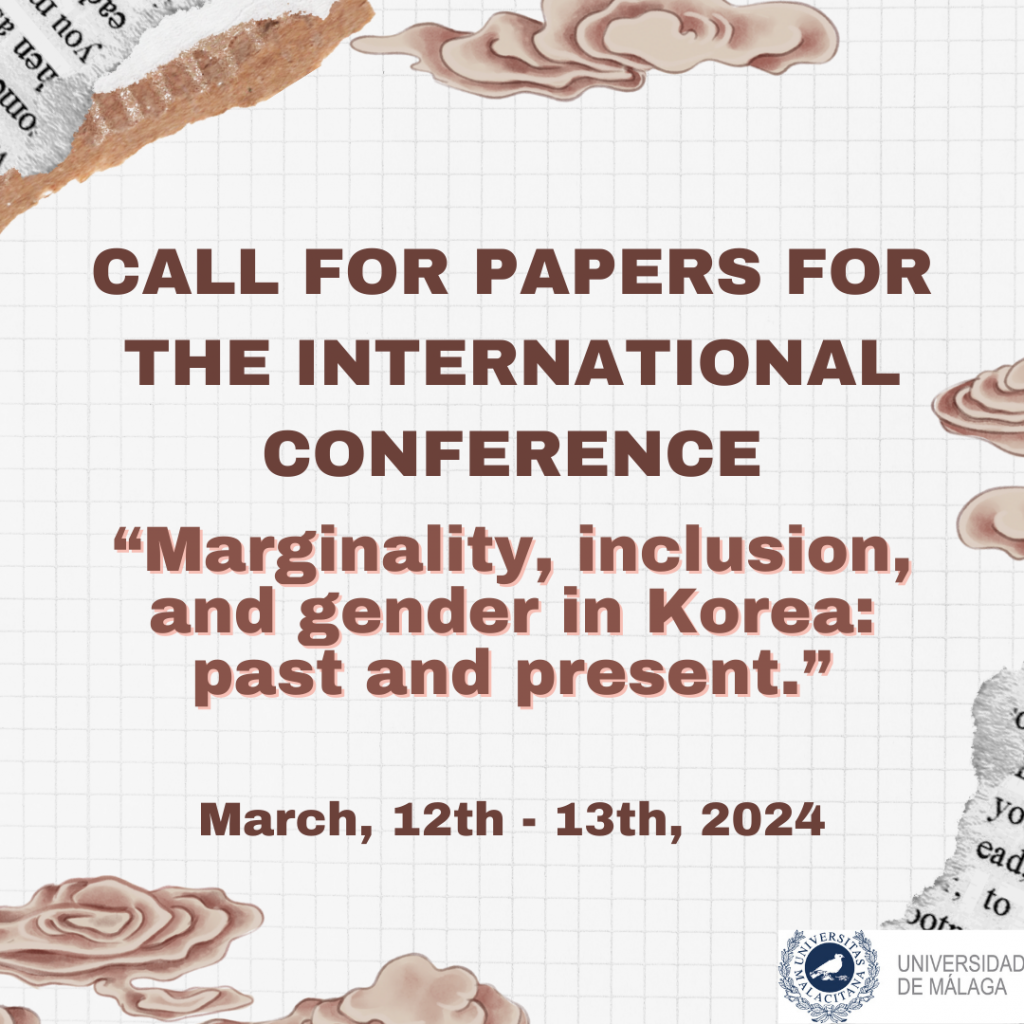
                          CFP: INTERNATIONAL CONFERENCE "MARGINALITY, INCLUSION, AND GENDER IN KOREA: PAST AND PRESENT"


                          International Conference

                          Marginality, inclusion, and gender in Korea: past and present


                          The East Asian Studies Area of the University of Malaga, Spain is pleased to announce the International Conference “Marginality, inclusion, and gender in Korea: past and present” on March 12th, 13th of 2024.

                          The Conference is organized as part of the research project Academy of Korean Studies Seed Program for Korean Studies (Advanced Track) “Path to Equality: Korean Studies Network on inclusiveness” (AKS-2021-INC-2250002) the Spanish National project I+D+I ASIA-SLAVES “The road to freedom in the Joseon period in Korea: Slavery and abolitionism in the context of East Asia” (PID2020-116910GB-I00) and the University of Málaga research project “Life Stories of Korean Gisaeng Slaves” (B1-2022_07).

                          This conference aims to consider the interrelated processes of discrimination and integration of social groups inside Korean society from a broad methodological and thematic perspective. This Call for papers encourages contributions dealing with the analysis of the cultural and institutional process of social discrimination in Korea, as well as political movements and institutional transformations directed to the integration of social groups previously discriminated against. The following topics are of interest, but are not limited to these: nobi system, discrimination against women, the situation of factory workers, disabled individuals, LGBTIQ+ communities, or migrant minorities. It is also considered of interest Korean social movements that through history have advocated for the rights of these marginalized groups, such as democratic unions in the 1970s and 80s, LGBTQ+ activists, or NGOs supporting disabled people and migrants.

                          The conference is organized in 4 panels to be composed by a maximum of 4 speakers.
                          • Panel 1: Gender, voices of women and gisaeng in Korea
                          • Panel 2: Slavery, force labour and human trafficking in Korea
                          • Panel 3: Social minorities in Korea
                          • Panel 4: Social and political activism in Korea
                          * Conference languages are English and Korean, and online presentations are permitted.


                          Proposal submissions

                          To propose an individual presentation, please send a maximum of 300-word abstract on the topic of your presentation (either in English or Korean). The proposals will be sent at the following account asiaoriental@uma.es. The file and subject of the email should include name as follow: Lastname_IntConferenceMIGKorea (ex: Kang_IntConferenceMIGKOREA). Submissions should be sent before November 15th, 2023

                          Abstracts should include:
                          1. Name, position and affiliation
                          2. Title of the paper
                          3. Abstract
                          4. Keywords
                          You will be sent a confirmation that your application has been received. If you do not receive a confirmation within 5 days after you sent it, please, send your application over again.

                          In the case of being selected, it will be expected to submit a full-paper before the conference with the possibility, after submission, of being selected for the publication in the format of an edited volume.

                          *Depending on the final budget the organization might support partially attendance expenses.


                          Important information:

                          Organizer contact details: asiaoriental@uma.es

                          Dates of the conference: March, 12th-13th, 2024.

                          Conference venue: University of Malaga, Spain.

                          Application deadline: November, 15th, 2023.

                          Submitting full paper: will be noticed after accepting proposals.

                          DIÁLOGO CASA ASIA "LO INSÓLITO: IMÁGENES A DESCUBRIR DE LA NARRATIVA COREANA DEL SIGLO XXI"


                          Diálogo Casa Asia

                          «Lo insólito: imágenes a descubrir de la narrativa coreana del siglo XXI»


                          En esta mesa redonda, asistiremos a un diálogo sobre la narrativa coreana actual desde una mirada que recupera lo insólito, lo extraordinario y un gusto latinoamericano por las historias fantásticas al estilo de Borges y Cortázar.

                          Este enfoque supone un desafío a nuestras expectativas respecto a historias de lo cotidiano, esta vez con varias autoras y autores coreanos que van desde la ciencia ficción y el terror hasta lo satírico.

                          Con esto queremos poner en valor la traducción reciente en España de libros de cuentos de Bora Chung como el finalista del prestigioso Booker Prize Conejo Maldito hasta la colección Aspirina de Park Min-gyu y ponernos en sintonía con narrativas coreanas que sorprenderán los gustos de lectores y lectoras.


                          Palabras de bienvenida:


                          Programa:
                          • Ponencia: Park Min-gyu, Bora Chung y Kim Cho-yeop: traducciones recientes al castellano de la imaginación coreana
                          Danilo Santos López, doctor en Literatura por la Universidad de Buenos Aires y director del Magíster en Literatura en la Pontificia Universidad Católica de Chile
                          • Ponencia: Mil tipos de azul de Cheon Seon-ran: solidaridad entre seres (in)completos a través de la imaginación literaria
                          Chaeyeon Park, profesora asociada de Estudios Coreanos en la Universidad de Salamanca y profesora de idioma coreano en el Centro Superior de Idiomas Modernos de la Universidad Complutense
                          • Ponencia: Rutinas atravesadas por lo extraño: la cotidianidad del siglo XXI imaginada en los cuentos de Kim Young-ha y de Han Kang
                          Paula Libuy Pulgar, doctoranda en Literatura de la Pontificia Universidad Católica de Chile, Magíster en Literatura y Licenciada en Letras Hispánicas por la misma institución.


                          Más Información:
                          • Fecha: Lunes 6 de noviembre, de 17.00 h a 18.30 h CET
                          • Lugar: Centro Casa Asia-Madrid, Calle Mayor, 69, Madrid

                          CFP: 2023 IKSU-K-UNIFICATION FRIENDS INTERNATIONAL CONFERENCE FOR YOUNG SCHOLARS


                          Tracing the Steps Toward Korean Unification: Learning from the Past to Prepare for the Future,

                          2023 IKSU International Young Scholars Conference


                          The International Institute of Korean Studies (IKSU) at the University of Central Lancashire (UCLan) is pleased to announce the 2-day 2023 IKSU International Young Scholars Conference. The conference aims to give junior scholars in the field of Korean studies and unification studies an opportunity to present their research, strengthen ties with other young scholars, and raise awareness of the unification issue in the Korean peninsula among the youth.

                          The conference aims to facilitate informed, interdisciplinary discussions on the potential benefits and challenges of Korean Unification by looking into how we can learn from the past toward preparing for the future. We are inviting young scholars aged between 19-34 including early career researchers who obtained their PhD degree in the recent five years and PhD candidates who are near to completion of their PhD programmes doing their research in relation to the theme of the forum.
                          • Submission Details: Abstract Submission Deadline (max. 500 words): 15 October 2023
                          • Acceptance Notice: 31 October 2023
                          • Full Paper Submission Deadline (min. 4,000 words including references): 20 November 2023
                          • Conference Dates: 1-2 December 2023.
                          Presenters will receive an honorarium of KRW 400,000 upon successful submission of a policy brief following the conference. Participants are expected to summarize their research into a 1-2 page-long policy brief that will be published through the Northern England Policy Centre for the Asia Pacific (NEPCAP) website.

                          CFP: "M32 - CITIES AND THE ENVIRONMENT UNDER TWENTIETH CENTURY AUTHORITARIAN REGIMES", EUROPEAN ASSOCIATION FOR URBAN HISTORY (EAUH) CONFERENCE


                          “M32 - Cities and the Environment under Twentieth Century Authoritarian Regimes”, 


                          Short abstract

                          This panel focuses on the environmental history of cities with particular focus on authoritarian regimes across the globe. The panel aims to incorporate papers analyzing the history of cities and the environment on both the political left and right starting from the Russian Revolutions until the collapse of the Soviet Union.


                          Session content

                          When historians of technology or the environment have investigated the environmental consequences of authoritarian regimes, they have frequently argued that authoritarian regimes have been unable to produce positive environmental results or adjust successfully to global structural change, if they have shown any concern for the environment at all. Put another way, the scholarly consensus holds that authoritarian regimes on both the left and the right generally have demonstrated an anti-environmentalist bias, and when opposed by environmentalist social movements, have succeeded in silencing those voices.

                          In contrast, this panel takes as its points of departure that authoritarian societies have developed environmentalist policies of their own, that environmentalism is a protean ideology, and that the sets of structures and priorities prevailing in the West represent only some of many possibilities.

                          The present panel aims to investigate the above described theory on the environmental history of cities with particular focus on authoritarian regimes across the globe. This panel aims to incorporate papers analyzing the history of cities and the environment on both the political left and right starting from the Russian Revolutions until the collapse of the Soviet Union. Although the panel's chronology is linked to the existence of the USSR, its focus is not confined solely to socialist cities, rather it aims to facilitate discussion between scholars working with rightwing and leftwing authoritarian regimes across the globe from Latin America, Asia and the Pacific, Africa and Europe.

                          Suggested themes for individual papers include:
                          • Politics and the environment in authoritarian regimes
                          • Urban planning under authoritarian regimes (construction/destruction, new concepts) and its environmental dimension
                          • Authoritarian regimes, cities and economic growth (impact of industry, commerce and networks)
                          • Water and the city (Urban water bodies, Municipal and industrial water and wastewater)
                          • Consumption and waste; waste management in authoritarian regimes
                          • Urban space, environmental disasters and their solutions in authoritarian regimes
                          • War, war preparation and the urban environment
                          • Air quality: heating, transport, industry
                          • Animals in the city
                          • Leisure and green spaces
                          • Suburbanization, motorization,
                          • City and its surroundings: urban metabolism
                          Any other theme that fits the proposed methodological and chronological frame of the panel is welcome!

                          Please submit your proposals by September 30, 2023.

                          Kindly see the submittal guidelines.


                          Contact Email

                          cesh@osu.cz

                          CFP: "AFRICA-ASIA AND THE WORLD" INTERNATIONAL AND INTER-TRANS-DISCIPLINARY OFFLINE AND ONLINE CONFERENCE


                          “Africa-Asia and the World”

                          International and Inter-Trans-Disciplinary Offline and Online Conference


                          AFRICA-ASIA AND THE WORLD: WHAT RELATIONS FOR GLOBAL PEACE, JUSTICE, PROSPERITY AND SUSTAINABILITY? 

                          International and Inter-Trans-Disciplinary Offline and Online Conference of:
                          • Inauguration of African-Asian and International Studies Institute AFRASI;
                          • Commemoration of the 65th Anniversary of the 1958 Accra All-African People’s Conference Ouagadougou, Burkina Faso, December 13-15, 2023 

                          Abstracts to be submitted online up to September 30, 2023 at here.

                          Contact: secretariat-afrasi@e-group.bandungspirit.org


                          INTRODUCTION

                          At the beginning of the new millennium, Africa remains a place where economic, geopolitical, and cultural interests from all over the world converge. Diverse summits with Africa have been organized regularly to shape the exchanges of the continent with global players (China-Africa/FOCAC, Japan-Africa/TICAD, India-Africa, Korea-Africa, Turkiye-Africa, Iran-Africa, Indonesia-Africa, Regular Commemorative Conferences of the Asian-African Conference, USA-Africa, EU-Africa, etc.). Another proof of the continent's importance on the world stage is the increasing presence of Asian countries such as China, India and Japan, or the return of historically relevant players such as Russia, not to mention the attempts of former colonizing powers to maintain their influence. Thus, the suspicious views of relations between Africa and Asia (especially China) and Eurasia (especially Russia) presented in the Western mainstream media do not do justice to the historical ties between Africa and Asia/Eurasia since at least the Bandung Conference (April 1955) characterized by their common struggles against colonialism and for independence.

                          Several points of convergence make it fair to focus on the Africa-Asia tandem. From a historical point of view, these are the continents that, despite European colonial ambitions, have retained their demographic and cultural bases, unlike other areas such as America and Australia, where colonial conquest and occupation were accompanied by the genocide of indigenous peoples, the suppression of their cultures and the installation of European culture, and where the descendants of colonial rulers and European immigrants continue to rule the areas to the present day. Moreover Africa and Asia shared common painful experiences of being colonized by European imperial power and common struggles for their independence at the same historical period (19th-20th centuries). In a world marked by global and diverse crises, Africa, and Asia, being distinctive in term of civilization from Western-dominated ones, have the potential to offer alternatives for rethinking their relationship with the world, based on imaginations, cultures, and development models different from the Western-led globalization. Considering demographic growth, projections predict that 80% of the world's population will be in Africa and Asia by the end of this century; this could be seen as a problem but also as an opportunity to take advantage of a tremendous human capital for the development of Asia and Africa, and concomitantly of the world. In economic terms, Asia has become Africa's leading trading partner. The search for new economic and political partners, particularly in Africa, signals that both continents will strengthen existing ties and find new avenues for cooperation. Convergence between Asia and Africa is also clear since they are confronted with common challenges, which includes poverty eradication and creation of social justice, security issues, the management of ethnic and religious diversity, and exploitation of natural resources for sustainable development and prosperity of people.

                          The international and inter-trans-disciplinary conference "Africa-Asia and the World: What Relations for Global Peace, Justice, Prosperity and Sustainability?" aims to reflect on these relations between Africa and Asia, as well as those between the African-Asian tandem and the rest of the world. Based on the diversity of approaches and disciplines of the speakers, this conference will be an opportunity to better understand and recommend policies of political, economic, and cultural relations to be developed between Africa and Asia, and with the rest of the world, to build a common future, based on more peace, justice, prosperity and sustainability.


                          ISSUES

                          The followings are non-exhaustive issues expected to be raised in the conference:
                          • Before and beyond hegemony of the West: what were and will be Africa-Asia relations?
                          • Africa-Asia and Africa-Eurasia: what convergence and what divergence?
                          • Africa, Asia, Eastern Europe and Latin America: do they continue to be the peripheries of the West?
                          • Africa-Asia Business Development: what challenges and what perspectives?
                          • MSME (Micro, Small, and Medium Enterprises) in Africa and Asia: what role in national economy and what mutual exchanges are possible?
                          • BRICS summit in Africa: what impacts on Africa?
                          • NAM, BRICS, Africa, Asia and Latin America: what synergy for a global restructuring?
                          • The West and Asia in Africa: what interests and what risks for Africa?
                          • The summits of China-Africa, India-Africa, Japan-Africa, Korea-Africa, Turkiye-Africa, Iran-Africa, Indonesia-Africa, EU-Africa, USA-Africa: what perspectives for Africa?
                          • FESPACO and BIFF (Busan International Film Festival): what relations are mutually and globally beneficial?
                          • African, Asian and American Tropical Forests: what challenges and perspectives for economy and ecology?
                          • Black-lives-matter: racism against African and Asian in the West, does it continue?
                          • Tradition, Culture and Religion: what role in patriarchy and gender issues?
                          • Indigenous and Imported Religions: what challenges and what perspectives for a peaceful co-existence or fusion?
                          • Languages and Nations: what place for former colonial languages in national independence and sovereignty?
                          • The Afrodescendant in America, Asia, Australia, Europe, Pacific and Oceania: who are they and what do they become?
                          • Demography, Migration, Urbanisation, Ruralisation: what planning and what mitigation?
                          • The G20 and the 20 poorest countries in the world: what relations?
                          • The G20 Summits: what impacts on Africa?
                          Other relevant issues will be welcome.


                          OFFLINE AND ONLINE PARTICIPANTS

                          The conference encourages the participation of scholars from a wide range of scientific disciplines (area studies, cultural studies, ecology, economics, geography, history, humanities, languages, management, political and social sciences...) and practitioners from diverse professional fields (business, civil society, education, enterprise, government, management, parliament, public policy, social and solidarity movements...) as well as artists, writers, journalists and activists of social and solidarity movements, based in diverse geographical areas (North, South, East, West, Central AFRICA; North, Central, South AMERICA; the CARIBBEAN; AUSTRALIA; North, East, West, Central, South and Southeast ASIA; Central, Eastern, Southern, Northern, Western EUROPE; RUSSIA, PACIFIC, OCEANIA...).


                          GUIDELINES FOR PRESENTER CANDIDATES

                          The selection of presenters is based on the abstract and the basic personal data of the presenter candidates in respect to the following dates:

                          1) Deadline of abstract (200-300 words) submission: September 30, 2023
                          2) Deadline of full paper (2000-3000 words / 5-6 pages) submission: October 31, 2023
                          3) Notification for the selected presenters: progressively from July 2023. The earlier an abstract is submitted, the earlier its author will get notified, which is important for a travel planning.

                          The abstract is to be submitted online.


                          FINANCING

                          The organising committee does not provide travel grant to any participant. The presenters as well as simple participants of the conference are supposed to find the necessary fund for their own participation (visa, international and national transport, accommodation).


                          Contact Information

                          Darwis Khudori, Faculty of International Affairs, University Le Havre Normandy, France

                          Contact Email: secretariat-afrasi@e-group.bandungspirit.org

                          CFP: EAST ASIAN ECOCINEMA CONFERENCE, UNIVERSITY OF IDAHO


                          East Asian Ecocinema Conference,

                          University of Idaho, February 22-23, 2024


                          Description:

                          Ecocinema has recently drawn scholarly attention in East Asian cinema studies, though usually within nation-state frameworks. This conference will contribute to exploration of ecological thinking with regards to media by encouraging inter-Asian conversations about ecocinema. Given the global issue of climate change, it is urgent to develop ecocritical perspectives beyond national cinema frameworks. For example, what can we learn about the relationship between cinema and natural disasters by comparing documentaries from Japan and China? How did filmmakers capture the changing cityscape and landscape during industrialization in different regions in East Asia? Challenging the Euro-America-centric discourse of Theory, what kind of ecocritical approaches and concepts are formed in media theories and criticisms in Asia? Can the increasing popularity of anime, which often reflects on natural disasters such as 3/11, inspire ecocritical thinking in the global audience? By providing scholars in East Asian cinema with a space for dialogue, this conference aims at mapping out alternative perspectives toward ecocinema beyond national borders.

                          This conference invites paper proposals from all areas in East Asian film studies. Interdisciplinary submissions from across the humanities are welcomed. Possible topics include but are not limited to the following:
                          • Catastrophe in anime
                          • Eco-activism by celebrities
                          • Ecocinema as a genre
                          • Ecocriticism and media theory in Asia
                          • Ecological documentary
                          • Environmentalist film
                          • New media and environment
                          • Non-anthropocentric worldview
                          • Sustainability and the film industry
                          Keynote speakers:

                          Submission process:

                          We invite scholars at all stages of their careers, across multiple disciplines as well as employing diverse methods and theories to submit proposals to this in-person conference. We will consider publishing selected contributions in an edited volume. The conference sponsor (the Idaho Asia Institute) will provide presenters with three nights lodging at a hotel in Moscow, Idaho (room shared with one other participant) and some meals. Participants will be expected to fund their own travel to and from Moscow, Idaho and other expenses.

                          Please submit the paper title, a 300-word abstract, and a short CV to Yuta Kaminishi (yutak@uidaho.edu) by July 30, 2023. Acceptance of proposals will be communicated by August 14, 2023.

                          Conference Organizers:

                          CFP: "THE MICRO AS MACRO; NARRATING WORLD HISTORIES OF SCIENCE, TECHNOLOGY, AND ENVIRONMENT" CONFERENCE


                          Graduate Student Conference

                          “The Micro as Macro: Narrating World Histories of Science, Technology, and Environment”,

                          UC Santa Cruz Center of World History Grad Student Conference; October 20, 2023


                          The UC Santa Cruz Center of World History is now accepting applications for papers or entire panels from presenters for our annual graduate student conference, "'The Micro as Macro': Narrating World Histories of Science, Technology, and Environment," to be held Friday, October 20, 2023 in Santa Cruz, CA. Since the early 2000s, the UCSC Center for World History has fostered a rich set of lectures, conferences, pedagogical workshops, and scholarly conversations in global, regional, and transnational histories. Those interested in presenting should submit a paper title and 300-word abstract. Please email your proposal to cwh@ucsc.edu by August 11.

                          While world history topics have expanded recently to include diverse areas, the Euro-American experience continues to dominate scholarship and is often treated as the assumed global model. The UCSC Center of World History invites paper proposals for its fourth (almost) annual graduate student conference, which explores non-European places and actors by centering on techno-scientific, environmental, sensorial, and spatial-based themes that reveal how the relationship between “small” subjects like microorganisms have shaped world history in ways that challenge or reimagine conceptions of progress and development. With this in mind, this conference will focus on histories spanning from 1700 to the present that tell global stories through small subjects such as viruses, cotton seeds, and metal alloys. By inviting a wide range of chronological and geographic loci, we hope to expand our definition of world history to one that does not default toward Euro-American experiences.

                          We hope to solicit individual papers that address the following topics:
                          • non-Western case studies that address techno-scientific, environmental, sensorial, and spatial-based themes
                          • Small subjects contributing to global histories
                          • Small subjects challenging Western epistemologies
                          • Small subjects informing/shaping indigenous communities
                          • Intellectual ways to challenge Western hegemony
                          We hope to focus on histories of science, technology, and the environment that highlight marginalized and micro histories. With conference presenters, we hope to apply new and needed insights to the ways in which we understand the past. Dr. David Fedman, Associate Professor of History at UC Irvine and author of Seeds of Control: Japan's Empire of Forestry in Colonial Korea, will deliver the keynote address.

                          We strongly encourage in-person participation, but the conference will have remote options for those who request it. For participants who do not have conference funding from their own institution, we have limited funds for travel support.

                          The deadline for proposals is Friday, August 11, 2023.

                          Proposals should include a paper title and 300-word abstract. Please email your proposal to cwh@ucsc.edu by August 11.

                          We look forward to reading your proposals!

                          Clara Bergamini, Piper Milton, Alexyss McClellan-Ufugusuku, Jinghong Zhang (Conference Organizing Committee)

                          CFP: “CHALLENGING RELATIONS WITH(IN) EAST ASIA”


                          Challenging relations with(in) East Asia”,

                          Academic Conference


                          The Vytautas Magnus University Centre for Asian Studies invites scholars of various academic fields of humanities and social science to submit proposals to an academic conference “Challenging relations with(in) East Asia” which will be held at Vytautas Magnus University (VMU, Kaunas, Lithuania) on November 3–4, 2023.

                          East Asia is one of the most dynamic regions in the world that is attracting global attention. As home to 1.6 billion people and almost a third of the world’s GDP, East Asia is often associated with growth, ambition, and innovation. As a result, East Asian countries have been establishing numerous bilateral and multilateral ties which created a complex network of governance of various spheres, ranging from economy to environmental protection. On the other hand, the region is not only a place of emerging opportunities, but also a hotspot of numerous risks and challenges. Tensions between North and South Korea, animosities among the neighboring countries due to historical legacies, display of military power in the Taiwan Strait – all this makes the international community very worried about the possible escalation and the negative impact it could cause to the whole world. It reveals that international relations both with and within East Asia can be challenging in numerous ways.

                          With all this in mind, the organizers of the conference invite participants from various academic fields to present their original research that is focused on intra- and inter- regional affairs that involve East Asia. Considering the recent developments, special attention will be given to presentations that deal with Taiwan related issues. The conference is not limited to one particular approach and encourages submission of proposals that can be classified under different fields of humanities and social sciences: anthropology, ethnology, history, sociology, economics, political science, etc. The working language of the conference is English.

                          Panel and individual paper proposals can be submitted by filling a form and sending it by email to conference.asc@vdu.lt by June 11, 2023.

                          The conference is organized by VMU Centre for Asian Studies and supported by Spotlight Taiwan.

                          CFP: 5TH ASIAN PHILOSOPHICAL TEXTS CONFERENCE


                          5th Asian Philosophical Texts Conference


                          Description:

                          This conference aims at providing a platform for scholars in the field of Asian Studies and world philosophies to discuss and reflect on the task of translating Asian philosophical texts (in the broadest sense) into western languages. This includes, but is not limited to, Chinese, Cambodian, Indian, Japanese, Korean, Mongolian, Vietnamese philosophical texts from any period. Any papers on the philosophy of translation, critical analyses of existing translations, or ongoing translation projects are welcome. Contributions from early- and mid-career scholars are welcome.

                          The conference is part of an ongoing international collaboration project involving the Université Libre de Bruxelles in Belgium and Kanda University of International Studies in Japan, with support from Akita University and the University of Edinburgh.


                          Information:

                          Dates: July 1-2, 2023

                          Venue: Kanda University of International Studies, Chiba

                          Submission deadline: June 1, 2023


                          Submission guidelines:

                          Please submit abstracts or papers to asianphiltexts[at]gmail.com. The abstract should be 300-500 words and the papers must be suitable for a 25–30 minute presentation (no more than 3500 words). All submissions must be in .doc, .docx or .pdf formats and should be prepared for blind review.

                          Please include in your email the following details: (i) author's name; (ii) paper title; (iii) word count; (iv) institutional affiliation; and (v) contact information.

                          If the presentations focuses on past or present translation projects, please make sure to send us the pdf of the original (which will be distributed to other presenters before the conference).

                          Responses to submissions will be sent by June 1, 2023.

                          Please send any questions to asianphiltexts[at]gmail.com.


                          Publication:

                          A selection of papers presented at the conference will be included in the fifth volume of the Asian Philosophical Texts book series, scheduled for publication in 2024. For more details about the book series, please visit the Mimesis International website.


                          Organizers: